

Alternatives to Boring Office Attire: 2026 Style Guide
Table of Contents
- Why Office Dress Codes Are Loosening (and What That Means for You)
- Business Casual Outfit Ideas That Beat the Usual Blazer-and-Trousers Routine
- How to Build a Capsule Wardrobe for Work Without Sacrificing Personality
- Layering Techniques for Climate Control and Style
- Color, Pattern, and Textural Contrast: Small Changes That Break the Monotony
- Statement Accessories That Do the Heavy Lifting
- Industry-Specific Dress Code Navigation: What Works Where
- Sustainable Fabrics and Ethical Sourcing for Workwear That Lasts
- Frequently Asked Questions
Last Updated: September 10, 2026
Why Office Dress Codes Are Loosening (and What That Means for You)
Workplace dress codes have shifted dramatically, and the alternatives to boring office attire have never been more varied or accessible. According to SHRM's workplace dress code research, a growing share of employers now permit business casual or smart casual every day of the week, retiring the formal suit-and-tie standard that dominated for decades. This shift is reflected in what customers buy: pieces that read polished in a meeting but feel like loungewear by 3 p.m.
Business casual sits between formal corporate wear and everyday casual clothing, typically allowing collared shirts, knit tops, tailored trousers, and clean footwear without a full suit. The loosening matters because it hands you control over silhouette, color, and fabric, exactly where personality enters.
Most guides get this wrong: "casual" isn't permission to stop trying. It's permission to dress with intention instead of obligation.
Business Casual Outfit Ideas That Beat the Usual Blazer-and-Trousers Routine
The fastest way out of a rut is replacing the two-piece uniform with a one-piece solution. A dress or jumpsuit removes the matching decision and reads more deliberate than a blazer-and-trousers pairing.
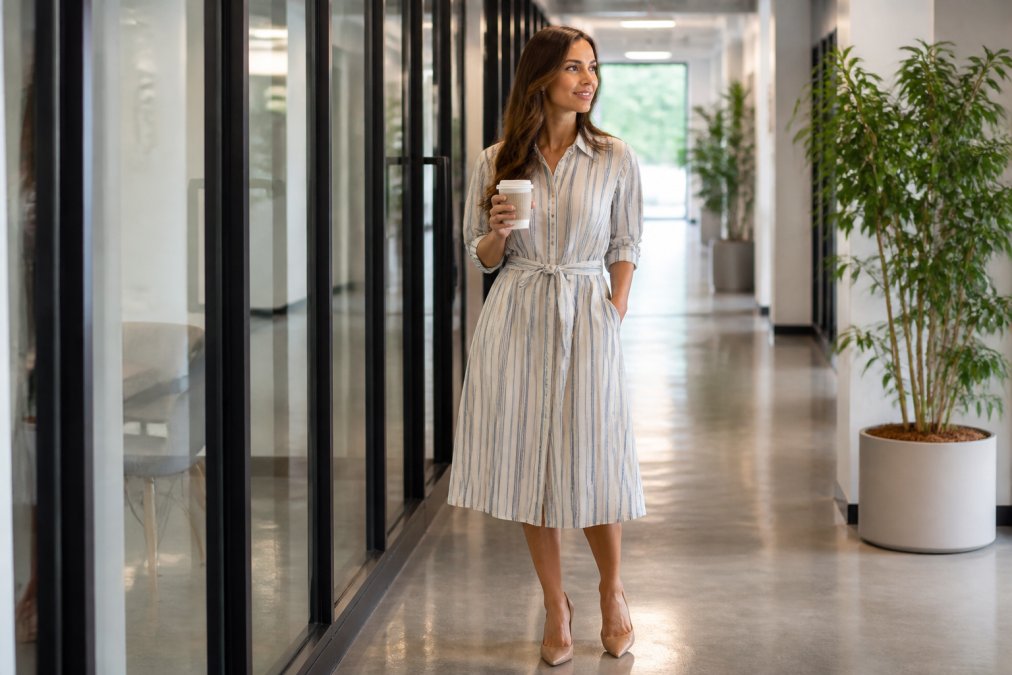
Shirt Dresses and Jumpsuits: One-Piece Solutions
The STRIPED UTILITY STYLE SHIRT DRESS W WAIST TIE is the workhorse. Its collared button-up front, patch pockets, and waist tie give structure, while the linen blend stays breathable all day. At $53.00, it does the job of three separates. A denim-look Tencel button-up dress offers the same ease, slightly more relaxed.

Elevated Knit Tops with Unexpected Details
When you build a two-piece look, let the top carry the interest. A mock neck top with shoulder pleats and a side tie adds architectural detail without shouting. Pair it with straight-legged trousers for an outfit that photographs well in any meeting room.

How to Build a Capsule Wardrobe for Work Without Sacrificing Personality
A capsule wardrobe for work is a small, coordinated set of garments that mix and match into many outfits. The goal isn't minimalism for its own sake; it's removing decision fatigue while keeping room for pieces that feel like you.
The 10-Piece Core and How to Stretch It
| Piece | Why It Earns Its Slot | Outfits It Unlocks |
|---|---|---|
| Neutral knit top | Layers under everything | 4+ |
| Statement mock neck top | Carries a two-piece look | 3 |
| Button-down shirt dress | One-and-done polish | 3 |
| Straight-legged trousers | The neutral base | 5+ |
| Midi wool coat | Structure over anything | 4 |
| Lightweight cardigan | Climate control layer | 4 |
| Knit sweater top | Softer meeting days | 3 |
| Denim-look dress | Casual Friday anchor | 2 |
| Statement watch | Finishes bare wrists | Every outfit |
| Structured tote | Carries the whole look | Every outfit |
Ten pieces, and the combinations run past twenty. Keep every piece in the same neutral palette so nothing fights.
Layering Techniques for Climate Control and Style
Layering solves the office temperature problem and adds visual depth. The rule: thin base, structured middle, statement outer.
A lightweight button-down knit cardigan works as the middle layer over a mock neck top, then comes off when the conference room heats up. For colder commutes, the PLUS LIGHTWEIGHT BUTTON DOWN KNIT CARDIGAN in burgundy adds a color accent without bulk.

Color, Pattern, and Textural Contrast: Small Changes That Break the Monotony
Monotony comes from sameness, not neutrals. Head-to-toe gray still looks interesting if the textures differ, but texture alone won't carry a full week.
Build a Three-Color Base Before You Add Anything
A workable office palette has three anchors: one deep neutral (navy, charcoal, chocolate), one light neutral (cream, stone, oatmeal), and one accent you actually like. Every piece should connect to at least two of the three. That's why capsule wardrobes work: the pieces don't just match, they multiply.
A common stylist pattern is the 60-30-10 split: 60 percent dominant color, 30 percent secondary, 10 percent accent. A charcoal trouser, cream knit, and burgundy cardigan can hit that ratio. Flipping it, burgundy trouser, burgundy top, cream shoe, can make an outfit read heavy.
Color Theory in Plain Terms
- Analogous colors sit next to each other on the color wheel (navy and teal, rust and burgundy). They create a calm, cohesive look that's hard to get wrong.
- Complementary colors sit opposite each other (navy and gold, olive and rust). Use them at low saturation for the office; full-strength complements read as costume.
- Value contrast is the difference in lightness between two pieces. High value contrast (cream against charcoal) reads crisp and formal. Low value contrast (stone against cream) reads soft and relaxed. This single variable does more for how professional an outfit looks than the colors themselves.
Pattern Rules That Actually Hold Up
Add one pattern, never three. A single striped piece against solid neutrals reads intentional; two competing patterns read chaotic. If you want two, keep them at different scales, a wide stripe with a small dot works, a wide stripe with a medium stripe does not.
Pattern placement matters: a pattern on top draws the eye up, on the bottom draws it down. If you're shorter, put the pattern on top. If taller, either works.
Textural Contrast Is the Quietest Tool You Have
Textural contrast combines fabrics with visibly different surfaces, smooth against ribbed, matte against slight sheen, to create interest without adding color. It's the quietest way to look styled and works in the most conservative offices.
Pair a smooth moss crepe top against a ribbed knit cardigan. Set a striped linen-blend dress against a smooth wool coat. A common guideline is one smooth, one textured per outfit. Two textured pieces can clash; two smooth pieces can flatten.
Making It Work Across Body Types
Color and pattern placement change how a silhouette reads, and the same outfit behaves differently by frame:
- Horizontal stripes add visual width. Use them on the area you want to emphasize, not the area you want to minimize.
- Vertical stripes add visual length. A vertical-striped trouser elongates the leg; a vertical-striped top elongates the torso.
- Color blocking at the waist creates a horizontal line. If you want to define a waist, block there. If you want to lengthen, keep the top and bottom in the same value.
- Dark bottoms, light tops is the most universally flattering value split and the safest starting point if you're unsure.
Doing This on a Budget
You don't need new pieces to test a palette. Lay out everything you own and sort by color family. Most people already own a workable three-color base and are missing only the accent. Buy the accent first, it's the cheapest piece and changes the most outfits. A single $30 burgundy cardigan can re-style five looks, about $6 per new outfit.
Statement Accessories That Do the Heavy Lifting
One strong accessory finishes an outfit faster than any clothing swap. A hinged oval bangle watch bracelet or a dark-dial chain bracelet watch adds a metallic note that pulls a neutral outfit together. But "add a watch" is where most guides stop, and why so many readers still feel stuck.
The real skill is scale. An accessory reads as intentional when its visual weight matches your frame and neckline. A common stylist pattern is the one-third rule: the accessory can occupy roughly a third of the visual space between chin and waistline (vogue.com). A chunky chain bracelet might overwhelm a petite wrist; the same bracelet might disappear on a taller frame. Matching the piece to the proportion, rather than just the trend, can be helpful.
Four Accessory Categories and What Each One Fixes
- Wrist pieces. A watch or bangle anchors a bare forearm and adds a horizontal line that breaks up a long sleeve. This is the highest-impact, lowest-risk category for conservative offices.
- Neck pieces. A single pendant or a short chain fills an open collar without competing with a lapel. Layered chains can read as casual in formal settings.
- Ear pieces. Studs and small hoops are often considered safe professional choices. Statement earrings can work in creative fields but are often best as the only prominent element in the outfit.
- Belts and bags. A structured tote or a slim leather belt in a contrasting neutral does more for a plain trouser-and-knit look than any jewelry.
Metal Mixing and the One-Loud-Element Rule
Mixing metals is fine when one dominates. If your watch is silver-tone, keep belt and bag hardware silver-tone too, and let a single gold ring be the accent. Two dominant metals can appear accidental rather than intentional.
A common guideline across every category is one prominent element per outfit. If the watch is the statement, the earrings might stay small. If the earrings are the statement, the wrist might stay bare. When everything else is quiet, a single well-chosen accessory can convey confidence.
Sizing and Fit Notes That Most Guides Skip
Accessories are the easiest place to shop size-inclusively because they don't depend on garment sizing. A few adjustments:
- Watch bands. Many standard bands run short for larger wrists. Look for adjustable links or a clasp with at least two extra holes, and check the listed band length in inches rather than assuming "one size."
- Bracelets. A bangle should slide over the widest part of your hand without pinching (realsimple.com). If it doesn't, size up rather than forcing it.
- Belts. Measure your natural waist over the clothing you'll wear the belt with, then add two inches. Belt sizing rarely matches pant sizing.
- Bags. Scale the bag to your frame the same way you scale jewelry. A tote that hits mid-thigh on a taller person will hit near the knee on a shorter one, which changes the whole silhouette.
Cost Per Wear Beats Sticker Price
A $40 watch worn three days a week for two years can have a low cost per wear. A $12 trend bracelet worn twice might have a higher cost per wear. Considering cost per wear can favor pieces you reach for often. Before adding an accessory, consider whether it will improve multiple outfits.
Industry-Specific Dress Code Navigation: What Works Where
The same outfit reads differently depending on where you work, the gap most style guides skip.
- Finance and law: Keep the midi wool coat and structured tailoring. Express personality through fabric and a single accessory, not through pattern.
- Tech and startups: Knit tops, denim-look dresses, and cardigans all pass. Lean into texture and color here.
- Creative and media: Pattern, statement watches, and unexpected silhouettes are assets rather than risks.
- Healthcare and education: Prioritize washable fabrics and closed-toe footwear; keep accessories minimal and secure.
When in doubt, observing the most senior person in your department can provide guidance.
Sustainable Fabrics and Ethical Sourcing for Workwear That Lasts
Fabric choice determines whether a piece survives a year of weekly wear, where cheap workwear fails first.
Linen-blend garments breathe and resist pilling, which matters for anything worn against the skin. Tencel drapes like denim but washes softer and holds its shape. Wool blends give structure and temperature regulation, and recycled polyester content reduces the demand for new material. Look for fiber content listed by percentage on the product page, not just a marketing claim.
Caring for these fabrics is straightforward: wash cold, dry flat or on low, and store knits folded to help prevent shoulders from stretching. A garment that lasts longer can cost less per wear.
Frequently Asked Questions
What are some modern alternatives to a traditional suit for work?
Swap the matching suit for a structured midi dress, a tailored jumpsuit, or wide-leg trousers with a knit top. A wool statement coat over any of these adds polish without stiffness. The goal is sharp lines and intentional fit, not formal matching. One well-tailored piece plus simple basics often reads more professional than a dated suit that fits poorly.
How can I dress professionally without looking boring?
Focus on three things: silhouette, texture, and one statement element. A mock-neck top with shoulder pleats in a rich color like dark coffee reads polished but not predictable. Add textural contrast, such as a knit cardigan over a linen-blend dress, and finish with a bracelet watch or bold earrings. Small, deliberate choices can help an outfit feel stylish.
How do I incorporate personal style into a corporate dress code?
Start with the dress code boundaries, then work within them using color, accessories, and fabric. If your office requires business casual, try a utility-style shirt dress in a stripe instead of plain navy. Use a statement coat, a vintage-inspired watch, or a patterned cardigan to signal personality. Keep the base professional and let one or two details carry your style.
What are the best fabrics for comfortable yet professional workwear?
Look for linen blends, merino wool, Tencel, and viscose-nylon knits. These breathe, resist wrinkles, and hold shape through a full day. A linen-blend shirt dress stays cool in summer, while a lightweight wool-blend cardigan layers without bulk. Avoid stiff 100% polyester unless it's a structured piece like a coat, where durability matters more than breathability.
How can I build a capsule wardrobe for work that isn't monotonous?
Anchor your capsule in neutrals (black, camel, navy, burgundy) and add two or three accent pieces in stripes, orange, or dark coffee. Include one statement coat, two dresses, three tops, two bottoms, and a layering cardigan. Rotate accessories and layering to create new combinations. A 10-piece capsule can yield over 20 distinct outfits when each piece works with at least three others.
The real challenge isn't finding alternatives to boring office attire; it's building a rotation that stays interesting after the fiftieth wear. That takes pieces designed to mix, which is exactly what D'LA Boutique curates: a plus-size collection, bamboo and modal blends, and dresses, rompers, and tops that move from desk to dinner without a change. Get started with D'LA Boutique and build a work wardrobe that finally looks like you.