

Create a Capsule Wardrobe on a Budget: Step-by-Step
Table of Contents
- What Is a Capsule Wardrobe and Why Budget Matters
- Start With a Wardrobe Audit: Assess What You Already Own
- Capsule Wardrobe for Beginners: Choose Your Color Palette and Basics
- How Many Pieces in a Capsule Wardrobe: Finding Your Perfect Count
- Build Your Capsule Wardrobe Checklist: Essential Items and Priority Order
- Capsule Wardrobe Outfit Ideas: Mix-and-Match Combinations That Work
- Smart Shopping Strategies: Where to Find Affordable Quality Pieces
- Maintain Your Budget Capsule Wardrobe: Care and Cost Per Wear
- Frequently Asked Questions
Last Updated: October 10, 2026
What Is a Capsule Wardrobe and Why Budget Matters
A capsule wardrobe is a small collection of versatile, high-quality pieces that mix and match to create multiple outfits, and building one on a capsule wardrobe budget means being strategic with your spending. Instead of owning 100 items you rarely wear, you build around 30-50 carefully chosen pieces that work together. This approach saves money, reduces decision fatigue, and helps you look intentional every day.
Quality costs more upfront, but a $60 piece worn 100 times costs 60 cents per wear, while a $20 fast-fashion item worn five times costs $4 per wear. Cost per wear reveals that quality wins.
A capsule wardrobe on a budget means being smart with limited funds so every dollar goes toward pieces that actually work in your life.
Start With a Wardrobe Audit: Assess What You Already Own
Before buying anything new, look at what you already have, most people own forgotten or unstyled pieces.
Pull everything from your closet and try things on. Notice which pieces make you feel confident and which don't. Be honest about fit, condition, and whether you'd actually wear them.
Ask yourself these questions:
- What do I wear in regular rotation?
- Which items make multiple outfits possible?
- What sits unworn and why?
- Are there gaps where I keep buying the same type of item?
- What needs repair or adjustment?
Take photos of your best pieces. You'll spot patterns, maybe you gravitate toward neutral colors or pair certain items together, that guide your capsule wardrobe choices.
This prevents duplicates and reveals your actual style preferences instead of guesses.
Capsule Wardrobe for Beginners: Choose Your Color Palette and Basics
Start by picking a color palette. Too many colors mean fewer mix-and-match combinations.
Choose 2-3 neutral base colors:
- Black, white, or gray
- Navy, olive, or tan
- Brown or camel
Then add 1-2 accent colors that make you feel like yourself. These become your foundation. Every piece you buy should work with these colors.
Neutral colors stretch your budget because they work together endlessly. A black blazer pairs with white shirts, navy jeans, tan pants, and gray sweaters. One piece multiplies outfit options.
The basics you need:
- White T-shirt or tee
- Neutral blazer
- Well-fitting jeans (light and dark)
- Simple sweater
- Basic tank top
- Neutral pants (khaki, gray, or black)
These six pieces form the skeleton of your capsule wardrobe. Quality matters because you'll wear them constantly, look for durable materials that hold their shape.
How Many Pieces in a Capsule Wardrobe: Finding Your Perfect Count
The magic number is 30-50 pieces, enough to create 50+ outfit combinations.

Here's how to think about it:
| Piece Type | Quantity | Reasoning |
|---|---|---|
| Tops (tees, blouses, shirts) | 8-10 | Mix and match with bottoms |
| Bottoms (jeans, pants, skirts) | 4-6 | Neutral colors work with most tops |
| Dresses | 2-3 | Casual and professional options |
| Outerwear (blazer, cardigan, jacket) | 2-3 | Layering extends seasons |
| Shoes | 4-6 | Neutral, professional, casual, active |
| Accessories | 5-8 | Scarves, belts, jewelry, hats |
| Undergarments | 7-10 | Basic staples |
Fewer pieces mean better quality and ensure you actually wear everything.
Adjust the formula to match your lifestyle. Someone working from home needs fewer professional pieces; someone in a warm climate needs fewer sweaters.
Start with 30 pieces and add strategically. Wait until you've worn your basics enough to know what you're actually missing.
Build Your Capsule Wardrobe Checklist: Essential Items and Priority Order
Start your capsule wardrobe with these priorities. Buy in this order so you build flexibility first.
Priority 1: Basics (buy first)
- 2 neutral tees
- 1 white button-up shirt
- 1 pair well-fitting jeans (light wash)
- 1 pair neutral pants (black or gray)
Priority 2: Layering (add next)
- 1 neutral blazer
- 1 cardigan or sweater
- 1 lightweight layer for spring/fall
Priority 3: Versatile pieces (fill gaps)
- 1 neutral dress
- 2 additional tops that match your palette
- 1 pair dark jeans or black pants
Priority 4: Finishing pieces (last)
- Shoes (neutral flats, professional heels, casual sneakers)
- Accessories (belt, scarf, simple jewelry)
- One statement piece that reflects your personality
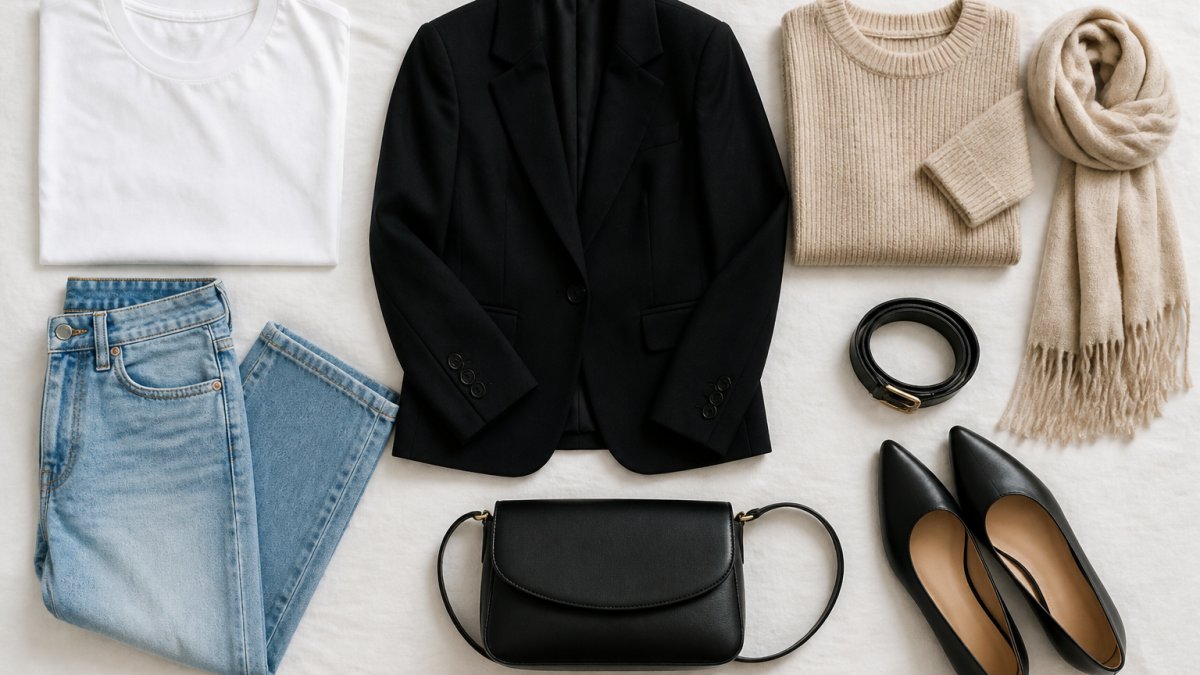
This order matters because basics create the most combinations. Prioritize flexibility first.
Capsule Wardrobe Outfit Ideas: Mix-and-Match Combinations That Work
A small number of pieces creates many outfits through strategic combinations:
Work outfit 1: Light jeans + white tee + blazer + flats
Work outfit 2: Dark jeans + neutral blouse + blazer + heels
Casual outfit 1: Light jeans + graphic tee + cardigan + sneakers
Casual outfit 2: Neutral pants + white tee + leather jacket + loafers
Mid Rise Stretchy Straight Leg Jean - LIGHT DENIM →
Weekend outfit: Neutral dress + jean jacket + sneakers + simple jewelry
Each outfit reuses the same pieces in different combinations, the blazer appears in three outfits, the white tee in four.
This is why color palette matters, if everything works together, you grab pieces without thinking, saving time and preventing impulse purchases.
Layering multiplies options: a basic tee becomes work wear with a blazer, casual with a cardigan and jeans.
Smart Shopping Strategies: Where to Find Affordable Quality Pieces
Your capsule wardrobe budget should prioritize shopping strategically for quality at reasonable prices, not bargains that fall apart.
Shop your closet first. Style existing pieces differently, wear that blazer with jeans instead of work pants.
Invest in basics, save on trend pieces. Spend more on items you'll wear 100 times, save on pieces you'll wear 10 times.
Buy secondhand strategically. Thrift stores, consignment shops, and online resale platforms (Poshmark, Depop, Vestiaire Collective, Goodwill's online auction site) have quality pieces at 40-70% off retail. But not all secondhand finds are bargains. Use this checklist before you buy:
- Fiber content: Check the tag. Natural fibers (cotton, linen, wool, silk) last longer than synthetics. Blends with at least 70% natural fiber hold up better than pure polyester.
- Seams and construction: Look for tight, even stitching. Pull gently on seams, they should not separate. Loose or fraying seams mean the piece is near end of life.
- Fabric condition: Feel the fabric. Does it pill? Pilling means fibers are breaking down. Is it stiff or brittle? That signals age and weakened fibers. Soft, supple fabric is a good sign.
- Stains and damage: Small stains in inconspicuous places can be treated. Large stains or permanent marks are not worth the risk. Check armpits, collar, and cuffs, these areas show real wear.
- Fit: Try things on or measure carefully. Secondhand pieces rarely have return policies. A $20 piece that doesn't fit is wasted money.
- Price reality check: A designer blazer at 50% off is still an investment. Compare the secondhand price to new basics from quality retailers. Sometimes new is smarter.
Secondhand shopping works best for basics and classic pieces, jeans, blazers, sweaters, button-ups. Trendy items are riskier.
Choose boutiques over fast fashion. An $80 pair of jeans lasts three years; a $30 pair lasts six months. The math favors quality.
D'LA Boutique's bamboo and modal blends hold their shape through repeated washing. The Mid Rise Stretchy Straight Leg Jean at $80 works with dozens of outfits and lasts for years.

Shop end-of-season sales. Buy your fall sweater in November, not September, you save money and know you actually want it.
Set a budget and stick to it. Divide it across priorities, for example, $500 might be $150 for basics, $150 for layering, $100 for bottoms, $100 for shoes and accessories.
Maintain Your Budget Capsule Wardrobe: Care and Cost Per Wear
Your capsule wardrobe only saves money if pieces last. Good care extends life, and tracking cost per wear teaches you what to buy next.
Understand cost per wear. Cost per wear = total price ÷ number of times worn.
Example: A $60 quality tee worn 100 times = $0.60 per wear. A $20 fast-fashion tee worn 5 times = $4.00 per wear. The expensive piece is actually cheaper in the long run.
Track your favorite pieces. After three months, count wears and divide price by that number. Use this data when shopping next time.
Sample budget breakdown and cost-per-wear targets:
If you have $600 to build a 35-piece capsule wardrobe:
| Category | Budget | Example Items | Target Cost Per Wear |
|---|---|---|---|
| Basics (tees, tanks) | $120 | 4 pieces at $25-30 each | $0.50-1.00 |
| Bottoms (jeans, pants) | $180 | 3 pieces at $50-70 each | $0.75-1.50 |
| Layering (blazer, cardigan, sweater) | $150 | 3 pieces at $40-60 each | $0.75-1.50 |
| Dresses | $80 | 2 pieces at $35-50 each | $1.00-2.00 |
| Shoes | $120 | 3-4 pairs at $30-50 each | $0.50-1.50 |
| Accessories | $50 | Belt, scarf, jewelry | $0.25-1.00 |
Basics and bottoms should have the lowest cost per wear because you wear them most. Dresses and accessories can be higher because they're worn less frequently.
Wash less frequently. Washing damages fabric more than wearing does. Wash only when pieces are actually dirty. Most items can be worn 3-5 times between washes. Washing damages fabric.
Use cold water and gentle cycles. Hot water fades colors and weakens fibers. Gentle cycles reduce wear. Air dry when possible. Dryers damage fabric faster than anything else.
Repair small problems immediately. A loose button takes five minutes to fix. A missing button ruins a piece. A small hole can be patched. A large hole means replacement. Fix things now.
Store properly. Hang items that wrinkle easily. Fold heavy knits to prevent stretching. Use cedar or lavender to prevent moths. Good storage means pieces stay in shape longer and don't need as much washing.
Invest in basics that last. This is why quality matters. A $30 shirt that falls apart after 10 washes costs more per wear than a $60 shirt that lasts 50 washes.
Track your actual wear. Keep a simple log. Every time you wear a piece, mark it down (or use a closet app like Stylebook or Cladwell).
A capsule wardrobe on a budget works because you're not buying constantly. You're buying strategically. You're choosing quality over quantity. You're taking care of what you own. You're tracking what actually works.
Frequently Asked Questions
How can a beginner start a capsule wardrobe?
Begin by auditing what you already own and identifying pieces that work together. Choose a neutral color palette (black, white, beige, navy) as your foundation. Start with five to seven versatile basics: well-fitting jeans, neutral tops, a blazer, and simple shoes. Add pieces gradually rather than buying everything at once. Focus on quality over quantity, and prioritize items that transition between work and casual settings. This approach prevents impulse buying and helps you build intentionally.
How many pieces should a capsule wardrobe have?
A functional capsule wardrobe typically contains 25 to 40 pieces, including tops, bottoms, dresses, outerwear, and accessories. For beginners, aim for 20 to 25 pieces to start, then add more as you identify gaps. The exact number depends on your lifestyle, climate, and how often you do laundry. Quality matters more than quantity; fewer high-quality pieces create more outfit combinations than many low-quality items. Track your cost per wear to ensure each piece earns its place.
What are the best basics for a budget capsule wardrobe?
Invest in neutral-colored essentials that mix and match easily: well-fitting jeans, white and black T-shirts, a simple button-up shirt, a neutral blazer, and basic sweaters. Look for bamboo and modal blends that offer comfort and durability without premium pricing. Include versatile shoes (white sneakers, neutral flats, work-appropriate heels). These timeless pieces work across seasons and dress codes. Avoid trendy items that date quickly; instead, choose classic silhouettes that remain relevant year after year.
How do I build a capsule wardrobe without buying everything at once?
Set a monthly budget and prioritize items based on your lifestyle needs. Start with basics you'll wear immediately: jeans, neutral tops, and shoes. Add layering pieces next, then accessories. Buy one to two items per week rather than splurging all at once. This approach spreads costs over time and gives you space to evaluate what actually works before investing more. Track outfit combinations to identify genuine gaps. Thrift stores and secondhand platforms offer affordable ways to expand without spending heavily upfront.