

Is Bamboo Fabric Good for Summer? What You Need to Know
Table of Contents
- Why Bamboo Fabric Summer Performance Stands Out
- Is Bamboo Fabric Moisture Wicking? The Real Answer
- Bamboo Fabric Pros and Cons for Hot-Weather Dressing
- Bamboo vs. Cotton and Other Summer Fabrics: Head-to-Head
- Processing Matters: Viscose vs. Lyocell and What It Means for Your Skin
- Fabric Weight and GSM: Choosing the Right Bamboo for Summer
- Layering Strategies for Summer With Bamboo Pieces
- How to Wash Bamboo Clothing So It Lasts
Last Updated: August 4, 2026
So, is bamboo fabric good for summer? The short answer is yes. At D'LA Boutique, we work with bamboo and modal blends daily, and the performance differences compared to conventional summer fabrics are real and measurable. Below, we'll break down exactly how bamboo behaves in heat, where it genuinely outperforms cotton and linen, and where the marketing sometimes gets ahead of the material science. The key distinction: bamboo fabric is excellent for summer, but only if you understand which type of bamboo fabric you're buying.
Why Bamboo Fabric Summer Performance Stands Out
Bamboo fabric earns its reputation as a summer staple through breathability, thermoregulation, and moisture management that few natural fibers can match. The fiber structure of bamboo-derived textiles contains micro-gaps along the cellulose strands, which creates continuous airflow channels against the skin. Bamboo doesn't just feel cool, it actively assists with heat regulation by allowing warm air to escape while drawing moisture away from the body surface.

Breathability and Airflow
Breathability is determined by fabric weave, fiber diameter, and air pockets within the yarn structure. Bamboo fabric, particularly in lighter GSM weights, scores well on all three. The fine filaments in bamboo viscose or lyocell create a looser, more open weave at the microscopic level compared to tightly spun cotton jersey. The practical result: wearing bamboo in humid summer heat feels less suffocating than wearing equivalent-weight cotton.
Thermoregulation and Cooling Effect
Bamboo fabric has relatively high thermal conductivity compared to cotton, meaning it transfers heat away from the skin more efficiently. According to the Textile Exchange's fiber benchmarking research, bamboo-derived fibers consistently perform well on comfort metrics in warm climates. The cooling effect is most noticeable in the first few minutes of wear and during physical activity.
Is Bamboo Fabric Moisture Wicking? The Real Answer
Bamboo fabric is moisture-wicking, but the mechanism differs from synthetic moisture-wicking fabrics like polyester. Bamboo absorbs moisture into the fiber itself rather than pushing it to the outer surface for evaporation. For everyday wear and social occasions, bamboo's absorption-based moisture management is preferable because it doesn't leave visible sweat marks as quickly as synthetic alternatives.
Once moisture is absorbed into the cellulose structure, it releases through evaporation as the fabric is exposed to air, which keeps the fabric from staying damp for extended periods. This is why bamboo performs well for night sweats and bedding essentials.
Bamboo Fabric Pros and Cons for Hot-Weather Dressing
Pros:
- Genuine breathability from the fiber's micro-gap structure
- Moisture absorption that prevents the immediate wet-fabric feeling
- Hypoallergenic properties that benefit sensitive skin in heat
- Natural antibacterial qualities that reduce odor buildup
- Exceptional softness and drape for casual and professional looks
- Biodegradable and more eco-conscious than synthetic alternatives
- Lightweight enough for summer layering without bulk
Cons:
- Viscose-processed bamboo loses some natural antibacterial properties during chemical processing
- Bamboo fabric wrinkles more readily than polyester blends
- Requires gentler washing than cotton
- Fabric quality varies enormously depending on processing method and GSM
- Higher-quality bamboo pieces cost more than fast-fashion cotton equivalents
The wrinkle issue is real. If you're packing for a summer trip, bamboo needs a steamer or quick iron on low setting.
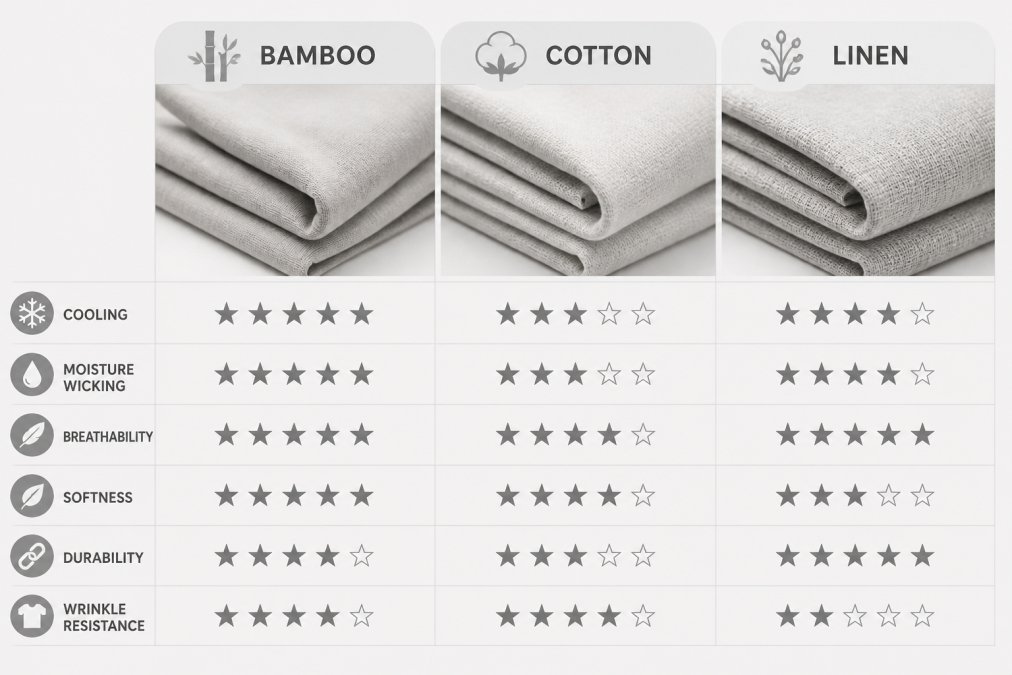
Bamboo vs. Cotton and Other Summer Fabrics: Head-to-Head
| Fabric | Breathability | Moisture Management | Odor Resistance | Eco-Friendliness | Softness | Wrinkle Resistance |
|---|---|---|---|---|---|---|
| Bamboo (Lyocell) | Excellent | Excellent | Good | Excellent | Excellent | Moderate |
| Bamboo (Viscose) | Very Good | Very Good | Moderate | Moderate | Very Good | Moderate |
| Cotton (Organic) | Good | Moderate | Low | Good | Good | Low |
| Linen | Excellent | Good | Low | Good | Moderate | Very Low |
| Polyester | Low | Good (synthetic) | Low | Poor | Low | Excellent |
| Modal | Very Good | Very Good | Good | Good | Excellent | Moderate |
Linen has comparable breathability to bamboo, but its rougher texture and severe wrinkling make it less versatile for professional settings. Cotton's moisture absorption is slower and it holds odors more readily than bamboo in humid conditions. Polyester's wrinkle resistance is unmatched, but its breathability is poor, making it uncomfortable in summer heat.
Processing Matters: Viscose vs. Lyocell and What It Means for Your Skin
Bamboo fabric is not a single thing. The raw bamboo plant must be chemically processed into fiber before weaving, and there are two primary methods: viscose and lyocell.
Bamboo viscose uses sodium hydroxide and carbon disulfide to dissolve cellulose, then extrudes it into fibers. The process produces very soft, drapey fabric, but uses significant chemical inputs and generates wastewater requiring careful treatment. Most "bamboo fabric" on the market is bamboo viscose.
Bamboo lyocell uses a closed-loop solvent process where the dissolving agent is captured and reused, dramatically reducing chemical waste and water consumption. The resulting fabric retains more of bamboo's natural properties, including better tensile strength and improved moisture management. As documented in the Federal Trade Commission's guidance on bamboo textile labeling, manufacturers must label bamboo viscose as "rayon made from bamboo" rather than simply "bamboo fabric" because processing so significantly alters the original fiber.
Allergy Triggers in Processed Bamboo
Bamboo fabric is widely marketed as hypoallergenic, and for most people, that holds true. The natural cellulose fiber has low allergenic potential. However, bamboo viscose processing removes most natural compounds that give raw bamboo its antibacterial properties. If someone experiences a reaction to "bamboo fabric," the trigger is more likely residual processing chemicals or fabric finishes than the bamboo fiber itself. People with chemical sensitivities should look for OEKO-TEX certified bamboo fabrics, which are tested for harmful residues. According to OEKO-TEX's Standard 100 certification criteria, certified fabrics are tested against over 100 harmful substances.
Fabric Weight and GSM: Choosing the Right Bamboo for Summer
GSM stands for grams per square meter, and it's the single most useful number for evaluating whether a bamboo fabric will perform well in summer heat. For summer wear, bamboo fabrics in the 100-180 GSM range are ideal:
- Under 130 GSM: Very lightweight, excellent airflow, ideal for tops and layering. Can feel slightly sheer.
- 130-180 GSM: Most versatile for summer dresses, blouses, and casual tops. Enough body to drape well without trapping heat.
- 180-240 GSM: Better suited for transitional seasons or air-conditioned environments.
- Above 240 GSM: Typically used for activewear, loungewear, or bedding.
If a retailer doesn't list GSM, the fabric weight description ("lightweight," "medium weight") is the next best indicator.
Layering Strategies for Summer With Bamboo Pieces
Bamboo fabric is ideal for summer layering because of how it manages heat accumulation across multiple layers. Bamboo as a base layer absorbs moisture and regulates temperature close to the skin, while outer layers in linen or open-weave cotton provide structure without trapping heat.
Practical layering approaches:
- Office transition: A lightweight bamboo camisole under a structured linen blazer. The bamboo manages sweat during the commute; the blazer provides professional structure indoors.
- Evening layering: A bamboo midi dress with a lightweight open-weave cardigan for air-conditioned restaurants.
- Weekend casual: A loose bamboo tee over high-waisted shorts or linen trousers.
Keep the bamboo piece as the layer closest to your skin. Its moisture absorption and thermoregulation work best in direct contact with the body.
How to Wash Bamboo Clothing So It Lasts
Bamboo fabric is more durable than its soft texture suggests, but requires more care than cotton. The fiber's tensile strength weakens when wet, so aggressive washing causes premature pilling and breakdown.
Follow these steps to protect bamboo pieces:
- Wash cold, always. Hot water breaks down bamboo cellulose fibers fastest.
- Use a gentle or delicate cycle. High-spin cycles create mechanical stress on wet fiber.
- Use a mild, pH-neutral detergent. Harsh detergents degrade bamboo cellulose.
- Skip the dryer when possible. High heat causes shrinkage and loss of drape.
- If you must use a dryer, use the lowest heat setting.
- Iron on low with steam to restore drape without damaging the fiber.
A bamboo piece washed correctly for a year will look nearly new; the same piece run through hot wash cycles monthly will show wear within months. For textile care standards, the American Association of Textile Chemists and Colorists testing standards provide benchmarks that responsible manufacturers test against.
Choosing summer clothing that genuinely performs in heat while looking polished is harder than it should be. Bamboo fabric solves the comfort side of that equation better than most natural fibers, but only when you know what to look for: the right processing method, the right GSM for the season, and the right care routine. D'LA Boutique's collection focuses on bamboo and modal blends specifically because these materials deliver on both comfort and contemporary style. Subscribe to D'LA Boutique emails to be first to know when new bamboo pieces drop and to get styling guidance sent directly to your inbox.
Frequently Asked Questions
Does bamboo fabric actually keep you cool in hot weather?
Yes, bamboo fabric is good for summer because its natural cellulose fiber structure allows for strong breathability and a high evaporation rate. The fabric pulls moisture away from the skin and releases it into the air, which creates a noticeable cooling effect. Bamboo's thermal conductivity also means it feels cooler to the touch than many synthetic alternatives. For best results, look for lighter GSM weights and lyocell-processed bamboo, which retains more of the fiber's natural properties.
Is bamboo fabric moisture wicking, or does it just absorb sweat?
Bamboo fabric does both: it absorbs moisture and wicks it away from the skin toward the outer surface where it can evaporate. This dual action is what makes it effective for summer wear and bedding essentials. Unlike pure cotton, which tends to hold moisture against the skin, bamboo moves sweat away more efficiently. This also contributes to its odor control performance, since less moisture sitting on the skin means less bacterial growth and less odor buildup throughout the day.
What are the downsides of bamboo fabric?
The main downsides are cost, care requirements, and processing concerns. Bamboo clothing typically costs more than conventional cotton alternatives. The fabric can shrink or lose shape if machine-washed on hot cycles, so it requires gentle handling. Bamboo fabric processed as viscose or rayon uses chemical-intensive methods that reduce eco-friendly claims. Some people with sensitive skin may also react to residual processing chemicals in lower-quality viscose bamboo, though lyocell-processed bamboo is generally considered cleaner and safer for skin sensitivity.
How do you wash bamboo clothing without damaging it?
To wash bamboo clothing correctly, use cold water on a gentle or delicate cycle. Choose a mild, pH-neutral detergent and avoid bleach or fabric softeners, which break down the natural fibers over time. Air drying is the safest option; if you use a dryer, set it to low heat. Avoid wringing the fabric, as this can distort the drape and tensile strength. With proper care, bamboo pieces hold up well through many washes, which is one reason quality-focused shoppers find them durable despite the higher upfront cost.
Is bamboo better than cotton for summer?
For most warm-weather use cases, bamboo outperforms standard cotton. Bamboo offers better moisture-wicking, faster evaporation, and built-in antibacterial properties that cotton lacks. It also has a softer drape, which many people find more comfortable against the skin during heat. Cotton does have advantages: it is widely available, generally less expensive, and easier to care for. If you run hot, experience night sweats, or have skin sensitivity, bamboo fabric is likely the better summer choice.
Is bamboo fabric basically polyester?
No. Bamboo fabric is derived from natural plant cellulose, not petroleum-based synthetics like polyester. However, the processing method matters. Bamboo viscose or rayon uses chemical solvents to break down the plant pulp, which can reduce biodegradable and eco-conscious claims. Lyocell bamboo uses a closed-loop process that recycles most solvents and is considered more sustainable. Neither is polyester. Both retain natural fiber benefits like breathability and moisture absorption that polyester cannot replicate.
This article was written using GrandRanker