

How to Find Unique Fashion Pieces Online
Last Updated: October 30, 2026
Quick Summary
To find unique fashion pieces online, search by garment plus detail and add a fabric or construction word, such as cotton poplin shirt or pleated midi skirt, instead of browsing broad trend terms. Use search operators, reverse image search, and small retailers' new arrivals pages, then save your searches and revisit them weekly.
- Write a three-line style brief with your colors, shapes, and no-go list before shopping.
- Quotation marks lock an exact phrase and a minus sign removes dominant retailers or trend terms.
- Check new arrivals pages on small retailers first, since small boutiques restock in small batches.
- Read the fabric composition line first and look for named fibers over vague poly blends.
- Match the size chart to a garment you own and find the return policy in one click.
Table of Contents
- Why Unique Fashion Pieces Are Worth the Search
- How to Find Your Personal Style Before You Shop
- A Practical Search Workflow for Finding Less-Common Pieces
- Online Boutiques for Women's Clothing: What to Look For
- How to Judge Quality Women's Clothing Online From the Listing
- Statement Pieces for Women: Choosing Ones You'll Actually Wear
- Authenticity, Seller Reliability, and Ethical Shopping Checks
- Browse D'LA Boutique's Curated Selection
- Frequently Asked Questions
Why Unique Fashion Pieces Are Worth the Search
Finding unique fashion pieces online takes more work than scrolling a fast-fashion feed.
Here is the honest math. Fast fashion wins on price and speed. It loses on fit, fabric, and staying power. A mass-produced top shows up on a dozen people at your office. A well-chosen independent piece does not.
Unique fashion is not about being loud. It is about being specific. A cut that flatters your frame, a color that suits your skin tone, a fabric that feels good at 4 p.m. on a Tuesday.
The search itself is the hard part. Most shoppers give up after two pages of results. Below, we show you exactly how to search, filter, judge quality, and buy with less risk.
How to Find Your Personal Style Before You Shop
The biggest mistake with online shopping is browsing before you know what you want. Most guides skip this step. It is the one that saves you the most money.
Start with what you already wear. Pull out the ten items you reach for most. Look for patterns:
- Colors that repeat
- Silhouettes that fit well
- Fabrics that survive your laundry routine
- Occasions you dress for most
Then write a short style brief. Three lines is enough: your colors, your shapes, your no-go list. Keep it open while you shop.
If you want a deeper walkthrough, our guide on the secrets to defining your personal style breaks the process into steps you can finish in an afternoon.
A Practical Search Workflow for Finding Less-Common Pieces
Most shoppers type a broad term, scroll, and buy whatever looks decent. A better workflow narrows fast and surfaces pieces you would never find by accident. The goal is not to browse more, it is to browse with a repeatable sequence that gets you to small-batch inventory before it sells out.
Here is the sequence we recommend, with the mechanism behind each step:
- Search by garment plus detail, not by trend. Try "cotton poplin shirt" instead of "cute tops." Detail words narrow the result set to listings that match a specific construction.
- Add a fabric or construction word. Linen, boucle, pleated, raw hem, double-breasted, and bias-cut all cut the noise. Two- and three-word queries return fewer but more relevant pages than one-word queries.
- Use search operators in the search bar. Quotation marks lock an exact phrase ("small batch linen"). A minus sign removes a dominant retailer or trend term (-shein, -dupe). Site-restricted searches (site:.shop) can surface independent storefronts that do not rank on broad terms.
- Run a reverse image search on a piece you already love. Upload a photo of a garment you own and wear often; image search returns visually similar listings.
- Check "new arrivals" pages on small retailers first. Small boutiques restock in small batches, so the newest page is where the least-common pieces live.
- Save searches and revisit them weekly. Set a calendar reminder.
That last step matters more than people think.
Search Terms That Surface Independent Designers
Broad terms return big retailers. Specific terms return small ones. Try these patterns:
- "[fabric] [garment]" such as "modal blend top" or "linen camp shirt"
- "[detail] [garment]" such as "velvet trim jacket" or "pleated midi skirt"
- "independent [category] brand" and "small batch [garment]"
- "[garment] made in [state or region]" to find domestic small makers
- "[garment] deadstock" or "[garment] sample sale" for limited-run pieces
Pair each pattern with a size term ("size 12", "petite", "tall") to cut listings that will never fit.
Using Filters and Saved Searches Without Missing New Arrivals
Filters are useful, but they can hide the good stuff. Use size and price filters, then sort by newest.
Set saved searches for your core categories, such as dresses, jackets, and accessories, and check them regularly.
If you want a structured approach to evaluating unfamiliar shops, our buyer's guide to finding boutique clothing covers the criteria in detail.
Here is the search sequence the article recommends, with the mechanism behind each step.
| Step | What to do | Why it works |
|---|---|---|
| 1 | Search by garment plus detail, not trend | Detail words narrow results to specific construction |
| 2 | Add a fabric or construction word | Two- and three-word queries return fewer, more relevant pages |
| 3 | Use search operators in the search bar | Quotes lock phrases; minus removes retailers; site: surfaces independents |
| 4 | Run a reverse image search on a loved piece | Image search returns visually similar listings |
| 5 | Check new arrivals pages on small retailers first | Small boutiques restock in small batches |
| 6 | Save searches and revisit them weekly | Set a calendar reminder |
Online Boutiques for Women's Clothing: What to Look For
A good online boutique for women's clothing lists fabric content, states its return policy clearly, and keeps its sizing consistent across products.
Metal Frame Oval Lens Sunglasses →
Look for these signals before you buy:
- Full fabric composition listed on every product page
- Measurements in inches, not just S/M/L
- Multiple model heights or customer photos
- A written return window you can find in one click
- Restock notices or a "back in stock" option
How to Judge Quality Women's Clothing Online From the Listing
You can judge a lot about quality women's clothing online from the listing alone. Fabric composition, construction notes, and care instructions tell you more than any product photo. The trick is knowing which lines to read first and what each one signals.
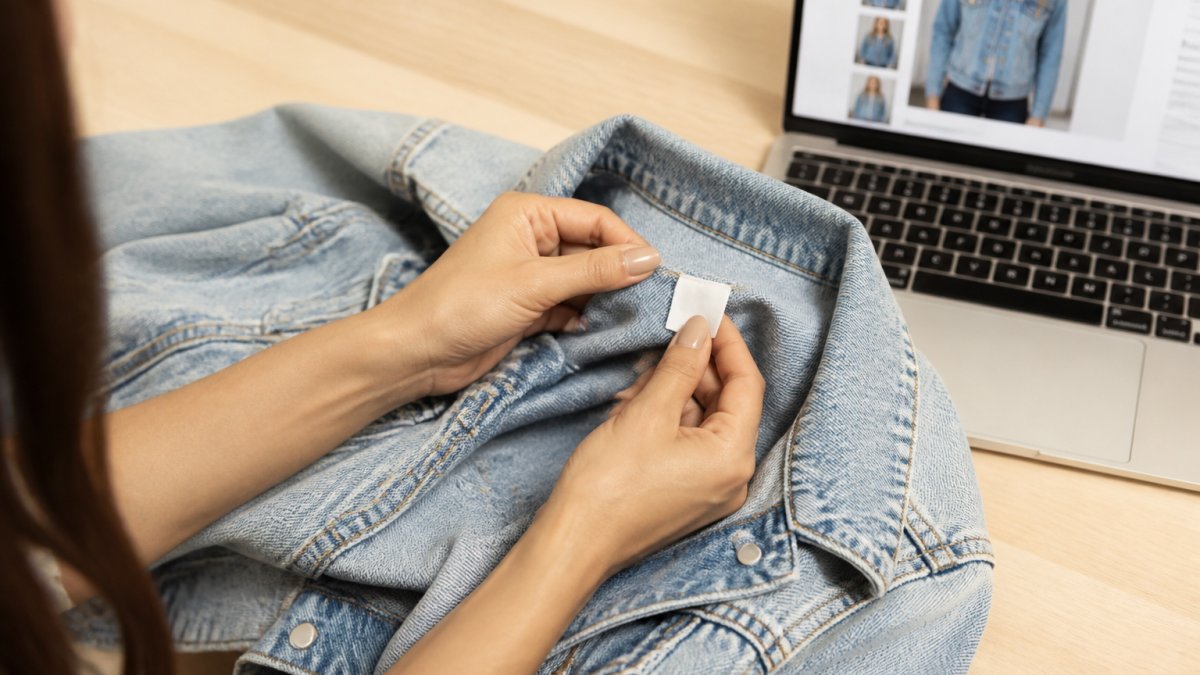
Read the composition line first. A jacket listed as 93% cotton, 6% polyester, 1% spandex lists its exact fiber content. Neither material is automatically better, the question is whether the fiber matches how you will wear the piece.
Fabric Composition and Garment Construction Clues
Look for these in the description:
- Named fibers: cotton, linen, wool, modal, bamboo. A named fiber is a better sign than a vague "poly blend."
- Stretch percentage: 1-3% spandex means structure with give. Above 5% usually means the garment will relax over a season.
- Lining notes: "not lined" matters for warm weather and for sheer fabrics. A lined jacket costs more to make and usually drapes better.
- Care instructions: machine wash cold means lower upkeep. "Dry clean only" on a casual piece is a warning about how often you will actually wear it.
- Construction words: French seams, bound edges, reinforced stress points, and functional buttons all signal a maker who expects the piece to last.
Sizing, Fit, and Return-Risk Reduction
Fit is where online shopping goes wrong most often. Reduce the risk before you click buy:
- Compare the size chart to a garment you already own and love. Measure that garment flat, then match it to the listing's measurements.
- Check bust, waist, hip, and length measurements, not just the S/M/L label. A size 12 in one brand is a size 8 in another.
- Read the return window and who pays return shipping before you buy.
- Buy one size in two options only when returns are free. Otherwise, buy the size that matches your measurements and skip the gamble.
- Look for multiple model heights or customer photos. One model at 5'9" tells you little about how a midi dress falls on a 5'3" frame.
For a deeper read on spotting superior fabrics, see our guide to high quality boutique clothing brands.
Statement Pieces for Women: Choosing Ones You'll Actually Wear
The best statement pieces for women earn their place by working with at least three outfits you already own. If a piece only works with one look, it is a costume, not a wardrobe item.
Test any statement piece against this checklist:
- Does it match two colors already in your closet?
- Can you wear it to work and to dinner?
- Does the fabric survive your normal laundry?
- Would you wear it more than four times a season?
A velvet-trim jacket, a bold scarf, or an oversized sunglass frame can all pass that test. Trendy prints usually fail it.
Authenticity, Seller Reliability, and Ethical Shopping Checks
Resale and vintage listings carry more risk than new retail. Verify the seller before you pay.
Run these checks:
- Search the seller's name for independent reviews
- Confirm the return policy in writing
- Ask for extra photos of tags, seams, and hardware
- Check whether the listing states fiber content and origin
For sustainable shopping, ask where and how a piece was made. Our questions to ask before buying sustainable fashion online lists the exact questions to put to a seller. Sellers who cannot answer are usually reselling without knowledge of the source.
Browse D'LA Boutique's Curated Selection
D'LA Boutique offers a curated selection of women's apparel, including dresses, rompers, tops, jeans, and jackets, a dedicated plus-size collection, and bamboo and modal fabric blends.
A few pieces that fit the advice above:
- The RISEN Basic Fitted Button Down Denim Jacket at $68.92, a layer that works over dresses and tops
- The HYFVE Plaid Collared Neck Boucle Jacket at $47.96, a textured statement layer for spring and fall
- The Ombre Polka Dot Print Satin Square Scarf at $13.99, an easy way to add color without committing to a whole outfit
- The Metal Frame Oval Lens Sunglasses Set at $15.99, a distinctive frame shape that finishes a look
Browse the full curated selection to see how these pieces fit together.


Frequently Asked Questions
How do I find unique clothing online without endless scrolling?
Start with a narrow search: use specific descriptors like the fabric, silhouette, or print you want rather than broad terms. Save searches on two or three curated boutiques and check their new arrivals weekly instead of browsing marketplaces daily.
How can I tell if an online boutique sells quality women's clothing?
Read the fabric composition and care instructions on every listing. A jacket that lists exact percentages, like 93% cotton, 6% polyester, and 1% spandex, tells you more than a vague high-quality claim. Check whether the listing includes product measurements by size, close-up photos of seams and hardware, and a clear return policy.
What should I look for when buying statement pieces for women online?
Look for pieces you can wear at least three ways. A plaid boucle jacket with pockets can be worn with a variety of trousers or dresses, which makes it more versatile than a one-outfit piece. Check the measurements against a garment you already own, confirm the return window, and compare the total cost including shipping before you commit.
Are online boutiques a good place to find unique fashion?
Yes, especially smaller boutiques that curate a limited selection rather than stocking everything. A curated selection means buyers have already filtered for style and quality, Check for real customer photos, sizing details, and a stated return policy, then start with one or two pieces to test the fit before building out your wardrobe.
The real challenge in finding unique fashion pieces online is not lack of choice. It is knowing how to search, how to judge a listing, and how to buy with less risk. That is the gap we built D'LA Boutique to close, with a curated range of women's apparel, bamboo and modal blends, a plus-size collection, and an easy checkout with multiple payment methods.
Get started with D'LA Boutique and build a wardrobe where every piece earns its place.
