

Minimalist Fashion Tips for a Timeless Wardrobe
Table of Contents
- Start With a Wardrobe Audit, Not a Shopping List
- Minimalist Wardrobe Essentials That Earn Their Space
- How to Declutter Your Closet in One Afternoon
- Your Capsule Wardrobe Checklist, With Quantities
- Minimalist Outfit Formulas You Can Repeat All Week
- Minimalist Fashion Tips for Buying Less but Better
- Care, Storage, and Making Pieces Last
- Conclusion
- Frequently Asked Questions
Last Updated: October 18, 2026
Start With a Wardrobe Audit, Not a Shopping List
Most people overhaul their closet the wrong way: they buy first and edit later.
Here's the uncomfortable truth: your closet is probably 70% dead weight, not because the clothes are bad, but because they don't fit your actual life. The blazer for a job you left.
Pull everything out. Yes, everything. Sort into three piles:
- Worn in the last 30 days, your real wardrobe
- Worn in the last year but not this month, seasonal or occasional
- Not worn in over a year, the honest pile
That third pile is where the decisions live. Be brutal. If you hesitated, it goes.
Minimalist Wardrobe Essentials That Earn Their Space
Minimalist wardrobe essentials are the pieces you reach for without thinking, working across seasons and occasions with minimal effort. The test isn't whether a piece is "nice", it's whether it earns its square footage.
The Foundations: Tops, Bottoms, and Layers
Start with a neutral color palette: black, white, cream, gray, navy, and one or two warm tones that flatter your skin. From there, build in three layers.
Tops should be comfortable enough for a full workday.
Bottoms come down to two or three reliable pairs: a mid-rise straight-leg jean in light denim for casual days, tailored trousers for the office.
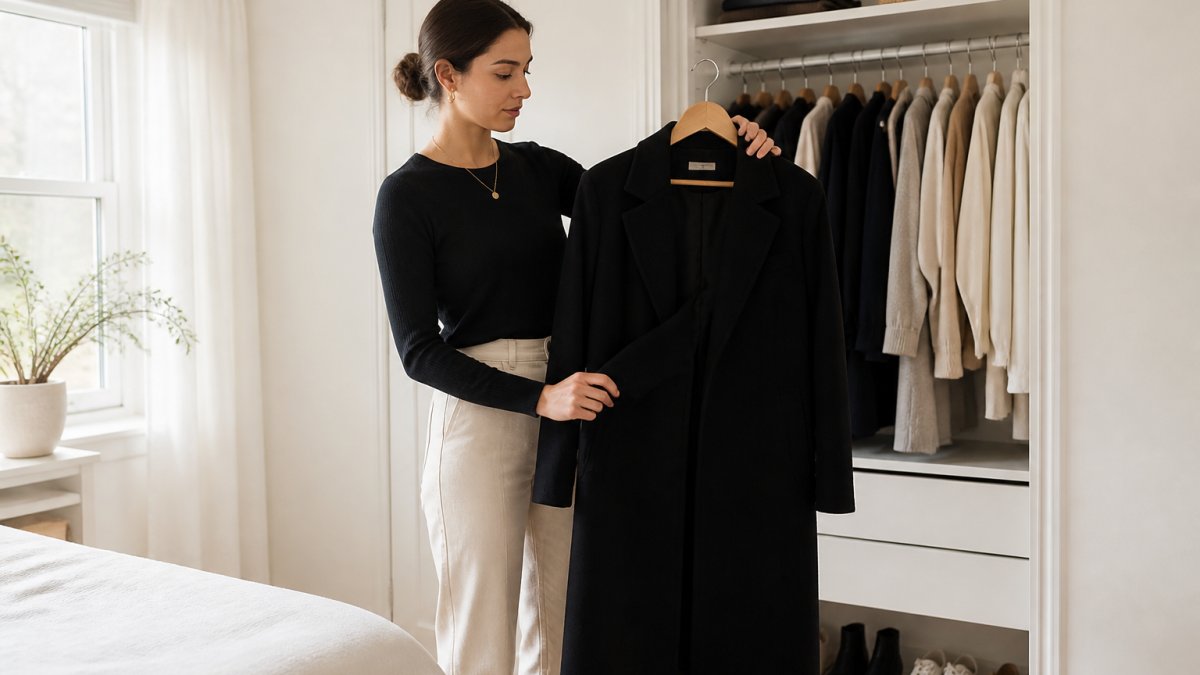
Layers are where versatility lives. A button-down cardigan, a fitted denim jacket, and one structured coat carry you through most of the year. The Prestige Wool Statement Coat is the kind of investment piece that anchors a minimalist wardrobe: a midi cut, sharp lapels, and a two-button front that reads polished over everything from a tee to a dress.

What to Skip
Skip anything that requires a specific other item to work, prints that match only one thing, the "statement" piece you'd wear twice a year, and fast-fashion duplicates, three cheap versions of the same top cost more over time than one that survives repeated washing.
How to Declutter Your Closet in One Afternoon
Decluttering a closet takes about three hours if you work in order and don't stop to try things on repeatedly. Set a timer and move fast. What makes a declutter stick is a decision rule for every item, not just a timer.
- Empty the closet completely (20 minutes). Everything onto the bed. Yes, everything, including the bin on the floor and the coat hook by the door.
- Clean the space (15 minutes). Wipe shelves, vacuum the floor, check for moths or damp. Look for tiny holes along wool seams and white specks in dark folds; both signal moths, and treating them now is cheaper than replacing a coat later.
- Sort into the three piles from your audit (45 minutes).
- Try the "maybe" items (30 minutes). Full outfit, mirror, honest light. Keep or release.
- Store off-season pieces (20 minutes). Clean, folded, labeled, out of the way.
- Return only the keepers (30 minutes). Organize by category, not color, so you can see gaps.
The Four-Question Test for Every "Maybe"
When you hesitate, run the item through four questions in order. One "no" is enough to release it.
- Fit: Does it fit the body you have today, not the body you had two years ago? Check the shoulders first on tops and jackets, a shoulder seam that sits past your natural shoulder bone cannot be tailored down cheaply, while a waist or hem can.
- Function: Can you name two specific places you will wear it in the next 30 days? "Somewhere nice" is not a place.
- Condition: Would you pay to repair it if it tore tomorrow? If not, it is not worth the closet space.
Fit Adjustments Worth Making Before You Release
Some "maybe" items are keepers with a small alteration. A tailor can shorten a hem, take in a waist, or shorten sleeves for a modest fee, often less than a replacement.
The same rules apply across body types, but checkpoints differ. If you are petite, watch for rises and inseams cut for a taller frame, a hem you roll every wear means the piece isn't working.
Decide Deliberately What Leaves the House
Sort the release pile into four streams:
- Donate: Clean, wearable items go to a local charity or shelter. Call ahead, many have specific acceptance lists, and some offer pickup.
- Resell: Pieces with resale value (recognizable brands, good condition, classic style) can go to consignment or an online resale platform. Expect a fraction of retail, so reserve this for items worth the listing effort.
- Recycle: Worn-out fabrics, stained tees, single socks, torn sheets, belong in textile recycling, not the trash. Many municipalities and retailers run drop-off programs accepting any condition.
Your Capsule Wardrobe Checklist, With Quantities
A capsule wardrobe checklist gives you a target number for each category so you stop guessing. Quantities below suit a four-season climate; adjust down for warm climates and up for cold ones.
| Category | Quantity | Notes |
|---|---|---|
| Tops (tees, blouses) | 6-8 | Mix of sleeveless, short, long sleeve |
| Bottoms (jeans, trousers, skirt) | 3-4 | At least one tailored pair |
| Dresses | 2-3 | One classic, one versatile day-to-night |
| Layers (cardigan, jacket, blazer) | 3-4 | One structured, two soft |
| Outerwear (coat) | 1-2 | One heavy, one light |
| Shoes | 4-5 | One flat, one heel, one boot, one sneaker |
| Accessories | 5-7 | Belt, scarf, bag, simple jewelry |
Warm climate: cut outerwear to one light layer and add two tops. Cold climate: add a second coat and one more knit layer.
Minimalist Outfit Formulas You Can Repeat All Week
Minimalist outfit formulas are repeatable combinations that remove morning decisions. Build five and rotate them.
Prestige Wool Statement Coat: Black →
- The workday baseline: tailored trousers + knit top + structured coat + loafers
- The casual default: straight-leg jeans + relaxed tee + denim jacket + sneakers
- The dinner swap: classic dress + cardigan + heel + simple jewelry
Each formula uses pieces from your checklist, mix and match within a small set and get more outfits from fewer clothes.

Minimalist Fashion Tips for Buying Less but Better
Buying less but better is the core discipline of minimalist fashion, and it starts with cost per wear: divide the price by the number of times you'll realistically wear a piece. A $68 coat worn 60 times a season costs about $1.13 per wear; a $25 trend jacket worn four times costs $6.25.
The harder questions are how to set a budget, decide what to buy first, and tell quality from marketing when price tags differ by a factor of ten.
Set a Budget Before You Set a Wish List
People who build wardrobes that last fund replacements from a standing annual budget rather than impulse. Pick a number you can spend on clothing over twelve months without stress, divide it into a quarterly allowance, and when it's gone, you wait, which forces you to prioritize.
A second pattern is the one-in, one-out rule: a new piece enters only when an old one leaves. It caps the closet at its current size and makes every purchase a deliberate trade rather than an addition.
Prioritize by Gap, Not by Want
After your audit, list gaps by how many outfits each would unlock. Neutral trousers that work with six tops beat a statement jacket that works with one outfit, even if the jacket is more fun. Buy the top two gaps, wear them for a month, then reassess, the second purchase usually changes what you want next.
Read Quality at Three Price Points
Quality is not the same as price, and the checks differ by tier.
- Entry level: Look for even stitching, no loose threads at stress points (armholes, crotch, pocket corners), and fabric that springs back when stretched. At this tier, prioritize fit and fabric content over brand. A plain cotton tee with dense knit outlasts a thinner one with a logo.
- Mid range: Construction details start to matter. Check whether patterns line up at seams, whether buttons are sewn with a shank (a small thread neck that lets the button sit flat over thick fabric), and whether the lining has a generous seam allowance. Ask about the return policy, a confident brand usually offers a real one.
- Investment level: You're paying for materials and longevity, so verify both. Wool should feel dense and recover when crushed; cashmere should be tightly knit, not loose and fuzzy. Check the fiber-content label and care instructions. A piece requiring dry cleaning after every wear carries a hidden cost, factor it into the real price.
The Pre-Purchase Checklist
Before buying, ask:
- Does it work with at least three things I already own?
- Can I name two occasions I will wear it this month?
- Does the fabric hold up to repeated washing, and can I care for it at home?
If any answer is shaky, wait a week. Most wants fade; gaps do not.
Care, Storage, and Making Pieces Last
Garment care separates a wardrobe that lasts from one that quietly degrades. Wash less often than you think: airing garments between wears extends their life more than any detergent.
- Gentle cleaning: cold water, mild detergent, inside out
- Proper storage: fold knits, hang structured pieces, use breathable garment bags
- Airing garments: 20 minutes outside after wear resets most pieces
Bamboo and modal blends hold up well with cold washing and low-heat drying. Denim should be washed sparingly and inside out. Wool needs a brush and air, not frequent cleaning.
Conclusion
Building a timeless wardrobe isn't about deprivation; it's about making every piece count. Start with an audit, set your quantities, learn your formulas, and buy with cost per wear in mind.
At D'LA Boutique, we built our collection around exactly this idea: versatile pieces in bamboo and modal blends, a dedicated plus-size range, and structured layers like our wool statement coat that work across seasons.
Frequently Asked Questions
How do you build a minimalist wardrobe from scratch?
Start by auditing what you already own and removing anything that does not fit or get worn. Then build outward from foundational pieces: a few neutral tops, one or two pairs of well-cut trousers or jeans, a blazer, a cardigan, and a coat. Add shoes and accessories last. Buy one piece at a time and wear it several times before buying the next, so you learn what your real gaps are instead of guessing.
What are the essential pieces in a timeless wardrobe?
The core set is smaller than most people expect: a fitted button-down, a soft knit tee, a cardigan, a blazer, tailored trousers, straight-leg jeans, a classic dress, a midi coat, and one pair of loafers. Choose neutral colors so everything mixes. Fabric matters as much as style, which is why bamboo and modal blends and structured wool hold up better over repeated wear than thin fast-fashion knits.
How many clothes should a minimalist wardrobe have?
Most people land between 30 and 40 pieces total, including shoes but excluding underwear and workout gear. The exact number matters less than the ratio: every piece should work with at least three others. If you can build a week of outfits from what remains after decluttering, you have enough. Adding more only helps when it fills a real gap you keep running into.
What colors work best for a minimalist wardrobe?
Build around two neutrals you actually wear, such as black and cream or navy and gray, then add one accent you love. A tight palette is what makes mix-and-match styling work, because every top pairs with every bottom. Test it by laying your clothes out together: if a piece clashes with more than two others, it is probably the wrong color for your closet, not the wrong outfit.
How do you create a capsule wardrobe that works across seasons?
Choose layers rather than separate seasonal wardrobes. A bamboo-modal tee works alone in summer and under a cardigan in fall; a wool coat covers late fall through early spring. Rotate only the pieces that genuinely cannot cross seasons, like heavy knits or sandals, and store the rest. This keeps your visible closet small while covering temperature swings without buying twice.
How can you make minimalist outfits look stylish?
Fit and fabric do most of the work. A plain tee in a soft bamboo-modal blend with a clean drape looks more considered than a busy print in thin cotton. Keep silhouettes simple, then vary texture: smooth knit against structured wool, denim against a soft cardigan. Add one deliberate detail, like a rolled sleeve or a tucked hem, and let the rest stay quiet.