

Modern Minimalist Fashion vs Classic Style: Key Differences
Table of Contents
- Modern Minimalist Fashion vs Classic Style: What Sets Them Apart?
- The Core Philosophy: Essentialism vs. Timelessness
- Key Differences at a Glance: A Side-by-Side Comparison
- Minimalist Wardrobe Essentials for Women: The Building Blocks
- How to Build Capsule Wardrobe That Blends Both Styles
- The Role of Sustainable Fashion and Ethical Consumption
- Which Approach Is Right for Your Lifestyle?
- Conclusion: Building a Wardrobe That Lasts
- Frequently Asked Questions
Last Updated: September 9, 2026
Modern Minimalist Fashion vs Classic Style: What Sets Them Apart?
The debate between modern minimalist fashion vs classic style often comes down to a simple question: are you dressing for the present moment, or for every moment that follows? Minimalism strips away the unnecessary to focus on clean lines and function, while classic style relies on enduring silhouettes that have proven their worth over decades. At D'LA Boutique, we see shoppers wrestle with this choice daily, and the answer rarely requires picking just one side.
Modern minimalist fashion prioritizes essentialism, clean silhouettes, and a restrained neutral palette over embellishments and trend-driven pieces. Classic style, by contrast, leans on established staples like tailored blazers, straight-leg denim, and structured coats that have looked correct for generations.
The practical difference shows up in how you shop. A minimalist buys a piece because it fills a specific functional gap in a coordinated system. A classic dresser buys a piece because it mirrors a proven template. Below, we'll break down where they diverge, where they overlap, and how to blend both into a wardrobe that actually works for your life.
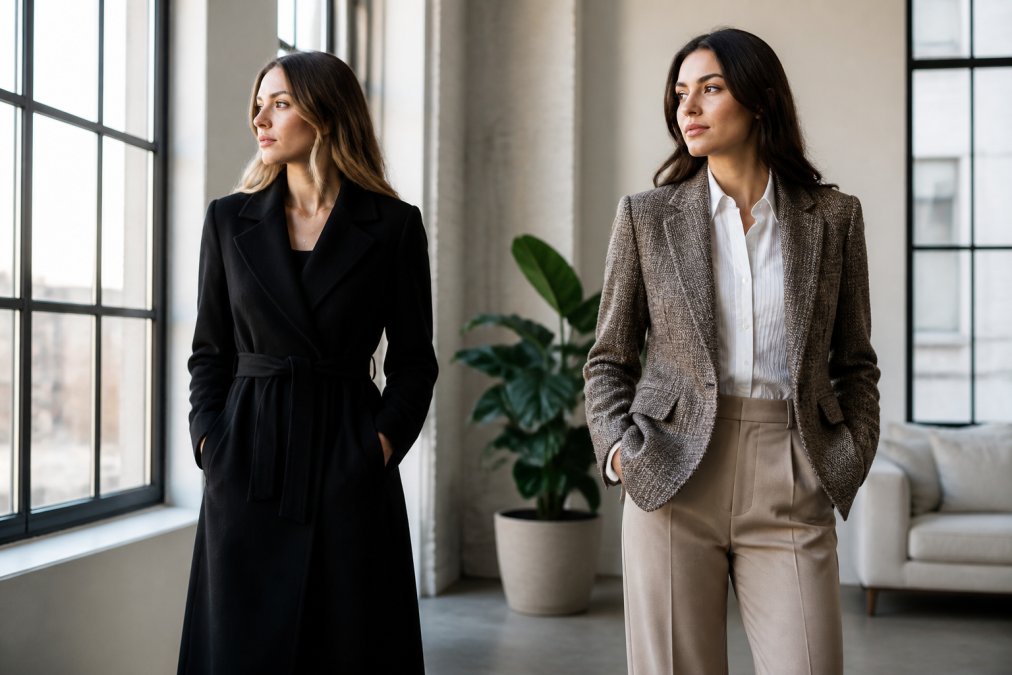
The Core Philosophy: Essentialism vs. Timelessness
Minimalism is built on essentialism: every item must justify its place by earning repeated wear. Classic style, meanwhile, is anchored in timelessness: the belief that certain garments, like a crisp white shirt or a well-cut trench coat, transcend seasons entirely.
The tension shows up in fabric choice and garment structure. Minimalists often gravitate toward modern technical fabrics and sustainable materials that prioritize comfort and ease of care. Classic dressers favor traditional constructions like wool tailoring and cotton weaves that have proven their durability. Both reject the disposable logic of fast fashion, but they express that rejection differently: one through forward-looking design, the other through proven tradition.
Key Differences at a Glance: A Side-by-Side Comparison
The fastest way to see where modern minimalist fashion and classic style part ways is to put them next to each other. The table below summarizes the main contrasts across the decisions you make most often.
| Consideration | Modern Minimalist Fashion | Classic Style |
|---|---|---|
| Color palette | Neutral palette with monochromatic layering | Neutrals plus enduring tones like navy and camel |
| Silhouette | Clean, architectural, often oversized | Tailored, structured, form-flattering |
| Fabric focus | Technical blends, bamboo, modal | Wool, cotton, traditional weaves |
| Purchase logic | Fills a functional gap | Repeats a proven template |
| Trend relationship | Avoids trends entirely | Absorbs trends slowly |
| Emotional feel | Effortless, modern, airy | Sophisticated, grounded, dependable |
Neither column is inherently better. The minimalist approach excels for busy women who want getting dressed to feel automatic, while classic style rewards those who enjoy the ritual of polished, traditional dressing. The overlap, and where most stylish wardrobes actually live, sits in the middle.
Minimalist Wardrobe Essentials for Women: The Building Blocks
Building a minimalist wardrobe essentials for women starts with identifying the pieces that do the heavy lifting across your week. A sharp outer layer tops the list. The Prestige Wool Statement Coat in Black at $68.00 exemplifies this: architectural tailoring, sharp lapels, and a minimalist button design deliver modern professional impact while the wool construction provides the quality and sophisticated texture that classic style also demands.

From there, the foundation moves to versatile bottoms. The Mid Rise Stretchy Straight Leg Jean in Light Denim at $80.00 offers a straight-leg silhouette that reads equally well with a minimalist tee or a classic button-down. For a darker, more polished option, the Dark Wash Cuffed Stretch Straight Jean at $95.00 provides the crisp lines and versatility needed for evening and office settings.

Accessories complete the system without adding clutter. A pair of Flat Rectangle Silver Hoop Earrings at $8.00 brings a polished minimalist touch, while the 18K Gold PVD Circle Ball Hoop Earrings at $23.40 offer a modern yet timeless aesthetic with hypoallergenic, non-tarnish construction that holds up to everyday wear.

How to Build Capsule Wardrobe That Blends Both Styles
Learning how to build capsule wardrobe that merges minimalist efficiency with classic polish comes down to a simple ratio: start with classic bones, then apply minimalist restraint. A capsule wardrobe is a curated collection of interchangeable pieces, typically ranging from 20 to 35 items, designed to mix and match across seasons and occasions (thecut.com). Here is a concrete, step-by-step method that blends the two aesthetics without leaving you staring at an empty closet.
Step 1: Define Your Weekly Rotation
Before buying anything, track what you actually wear for two weeks. Most women discover that 80 percent of their outfits come from roughly 10 to 12 core pieces (hbr.org). That list becomes your capsule's foundation. If you work in an office three days a week, your capsule needs more tailored bottoms. If your schedule is fluid, prioritize layers and versatile dresses that transition from day to evening.
Step 2: Choose Your Classic Anchors First
Classic style provides the structural bones. Select five to seven pieces that have proven their worth across decades: a tailored blazer, a crisp white button-down, a trench coat or structured wool coat, a dark-wash straight-leg jean, a versatile sheath dress, and a quality knit sweater. These are your investment pieces, where construction and fabric matter most. The key is choosing silhouettes that have remained unchanged for 20 years or more.
Step 3: Apply Minimalist Editing Rules
Now the minimalist filter kicks in. For every additional piece beyond your classic anchors, apply three tests:
- The Three-Outfit Test: Can this item create at least three distinct outfits with pieces already in your capsule?
- The Color Test: Does it fall within your chosen neutral palette (black, white, beige, gray, navy, camel)? If it introduces a new color, it must coordinate with at least 80 percent of your existing pieces.
- The Duplicate Test: Does it replace something you already own, or does it duplicate a function? If you already have a black blazer, a second one must serve a clearly different purpose, such as a different weight for warmer months.
Step 4: Fill the Gaps with Minimalist Essentials
After your anchors and editing rules are in place, add the minimalist workhorses that make the system function: a modal or bamboo-blend tee in black and white, a pair of tailored trousers with a clean, straight leg, and a simple slip dress that works alone or layered under a blazer. The goal is not to reach a specific number but to ensure every item earns its place through frequency of wear.
A Sample 10-Piece Capsule That Blends Both Styles
Here is a concrete example of a 10-piece capsule that merges classic anchors with minimalist restraint. This works for a woman in a business-casual office environment with weekend social activities:
| Piece | Style Role | Why It Works |
|---|---|---|
| Tailored wool blazer in black | Classic anchor | Instantly elevates jeans or trousers |
| White cotton button-down | Classic anchor | Works alone or under the blazer |
| Camel cashmere-blend sweater | Classic anchor | Adds warmth and texture without bulk |
| Dark-wash straight-leg jeans | Classic anchor | Transitions from office to weekend |
| Black tailored trousers | Minimalist essential | Clean line, pairs with every top |
| Black modal-blend tee | Minimalist essential | Soft, breathable, no ironing needed |
| White modal-blend tee | Minimalist essential | Same versatility as black, different contrast |
| Black slip dress | Both | Worn alone in summer or under blazer in winter |
| Structured wool coat | Classic anchor | The outer layer that ties everything together |
| Black leather loafers | Both | Comfortable, polished, season-spanning |
With these 10 pieces, you can create at least 25 distinct outfits. Add two or three seasonal items, such as linen trousers for summer or a heavier knit for winter, and the system extends year-round without ballooning your closet.
The Editing Mistake That Undermines Most Capsules
The most common failure is not owning too few pieces but owning pieces that do not coordinate. A capsule fails when you include a printed blouse that only matches one pair of pants, or a colored handbag that clashes with your neutral palette. The discipline is not deprivation; it is ensuring that every piece multiplies your options rather than dividing them. When you stick to a cohesive palette and classic silhouettes, 10 pieces can generate more outfits than 50 mismatched items.
Budget-Conscious Capsule Building
The assumption that capsule wardrobes require high-end investment is one of the biggest myths in fashion content. A functional capsule can be built for under $300 if you prioritize fabric content and construction over brand names. Look for wool-blend coats at outlet stores or secondhand shops, where quality tailoring is often available at a fraction of retail. For basics like tees and trousers, bamboo and modal blends from direct-to-consumer brands offer the same comfort and drape as premium labels at $20 to $40 per piece. Spend more on items you wear daily and that require structural integrity, like coats and blazers, and spend less on items that are easily replaced, like basic tees.
The Role of Sustainable Fashion and Ethical Consumption
The sustainability conversation in fashion has moved far beyond vague promises about being 'eco-friendly.' Both minimalist and classic approaches to dressing intersect with environmental impact in concrete, measurable ways, but the mechanisms differ significantly.
How Minimalism Reduces Environmental Impact
Minimalism's core mechanism is straightforward: fewer purchases mean less demand for resource-intensive production. A minimalist wardrobe of 30 pieces worn 200 times each has a dramatically lower per-wear environmental cost than a fast-fashion wardrobe of 100 pieces worn 10 times each.
The second mechanism is material choice. Minimalist fashion often prioritizes technical fabrics and sustainable materials like bamboo, modal, and recycled polyester. Bamboo and modal are derived from renewable wood pulp and require significantly less water than conventional cotton. However, not all sustainable materials are created equal. Bamboo viscose, despite its natural origin, undergoes chemical processing that can be environmentally harmful if not properly managed. Look for certifications to verify that the processing meets environmental and social standards.
How Classic Style Extends Garment Lifecycles
Classic style contributes to sustainability through a different mechanism: durability and longevity. When you invest in a wool coat or a tailored blazer designed to last a decade, you are extending the product's lifecycle and reducing the need for replacement.
The key metric is cost-per-wear. A $300 wool coat worn 100 times costs $3 per wear (investopedia.com). A $50 polyester blazer worn 10 times before falling apart costs $5 per wear, and it ends up in a landfill. Classic style's emphasis on traditional materials like wool, cotton, and linen also supports this longevity, as these fibers are naturally durable and can be repaired or recycled more easily than synthetic blends.
The Intersection: Slow Fashion as a Shared Value
The term 'slow fashion' emerged in the late 2000s as a counter-movement to fast fashion's rapid production cycles and disposable logic. Both minimalist and classic approaches align with slow fashion principles, but they express that alignment differently. Minimalism reduces consumption by design, while classic style extends the lifecycle of individual garments. Together, they represent a shift from a linear model to a circular model, where clothes are made well, worn often, and eventually repaired, resold, or recycled.
The Greenwashing Trap You Need to Avoid
The biggest trap in both approaches is treating sustainability as a marketing label rather than a set of verifiable practices. A $200 minimalist dress made from 'recycled' polyester may still be produced in a facility with poor labor standards. A 'classic' blazer from a fast-fashion brand may use the same cheap construction as its trendier counterparts, just with a more conservative cut. The fashion industry has no universal standard for sustainability claims, so you must evaluate each purchase on its merits.
Ask three questions before any 'sustainable' purchase:
- What is the fabric content? Natural fibers like organic cotton, wool, and linen have lower environmental footprints than virgin polyester. Recycled synthetics are better than virgin but still shed microplastics during washing.
- How is it constructed? Look at seams, lining, and finishing. A garment with reinforced stitching, quality buttons, and a proper lining will outlast a cheaper version regardless of the label.
- Who made it and where?
Practical Steps for Sustainable Wardrobe Building on Any Budget
Sustainability does not require a high-end budget. Thrift stores and secondhand platforms offer access to quality wool coats, tailored blazers, and classic denim at a fraction of retail prices. Buying secondhand extends the lifecycle of existing garments and keeps them out of landfills, making it one of the most effective sustainability strategies available. For new purchases, prioritize brands that offer repair services or take-back programs, which keep garments in circulation longer.
The Cultural Shift Toward Conscious Consumption
The rise of minimalist and classic dressing reflects a broader cultural shift away from the disposable logic that dominated fashion in the 1990s and 2000s. The capsule wardrobe movement and the growing popularity of 'shopping your own closet' represent a direct response to this waste. When you adopt either minimalist or classic principles, you are not just making an aesthetic choice; you are participating in a larger movement toward more intentional, ethical consumption that values quality over quantity and longevity over novelty.
Which Approach Is Right for Your Lifestyle?
The honest answer depends on your daily context more than your personal taste. If you work in a corporate office where polished, professional presentation matters daily, classic style offers a dependable framework that never needs explaining. If your schedule shifts between meetings, errands, and evenings out, modern minimalist fashion provides the effortless style and functional dressing that moves seamlessly between contexts.
Budget also plays a role. Both approaches support budget-conscious minimalism, but they spend differently. Classic style concentrates investment in traditional anchor pieces like tailored blazers and wool coats. Minimalism distributes investment across fewer, more versatile items that earn their cost through frequency of wear. Both reject the buy-more-spend-less trap of disposable trends.
There is also a middle path worth considering. Many women find that a classic foundation with minimalist styling, clean silhouettes, monochromatic layering, and a restrained neutral palette, delivers the best of both. The structure and polish come from classic tailoring; the ease and modernity come from minimalist restraint.
Conclusion: Building a Wardrobe That Lasts
The choice between modern minimalist fashion vs classic style does not have to be permanent. Most well-edited wardrobes blend the two: classic anchors for structure and dependability, minimalist principles for editing and restraint. What both approaches reject, and what ultimately defines a successful wardrobe, is the disposable cycle of trend-chasing.
At D'LA Boutique, we build our collections around this intersection. Our pieces combine the comfort of bamboo and modal blends with the clean silhouettes that minimalist dressing demands, and the quality construction that classic style requires. From the architectural lines of the Prestige Wool Statement Coat to the timeless cut of our straight-leg denim, every item is chosen to earn its place in your rotation for years, not weeks. The most sustainable wardrobe is the one you actually wear, and the most stylish one is the one that makes getting dressed feel effortless. Subscribe to our emails for styling guidance and new arrivals that fit your system.
Frequently Asked Questions
What is the difference between modern minimalist fashion and classic style?
Modern minimalist fashion emphasizes reduction, clean silhouettes, and a neutral palette, often with an architectural or contemporary feel. Classic style prioritizes timeless, well-tailored pieces like blazers and straight-leg jeans that have proven their longevity. Minimalism is a design philosophy about editing down to the essential. Classic style is about enduring elegance and tradition. You can wear both, but minimalist fashion often feels more current, while classic style focuses on pieces that look appropriate for decades.
How can you blend minimalist and classic elements in a capsule wardrobe?
Start with classic wardrobe staples like a quality wool coat and straight-leg jeans as your foundation. Then, apply minimalist principles by choosing these items in a cohesive neutral palette and avoiding decorative embellishments. For example, a black Prestige Wool Statement Coat offers a classic silhouette with minimalist, architectural tailoring. This approach gives you the longevity of classic style with the refined, uncluttered aesthetic of modern minimalism.
Is minimalism still popular in 2026?
Yes, minimalism remains a relevant choice, but it has evolved. The focus has shifted from stark, empty aesthetics toward intentional dressing and sustainable fashion. Modern women are using minimalist principles to combat fast fashion by investing in fewer, higher-quality pieces that offer versatility. In 2026, minimalism is less about a strict uniform and more about a thoughtful approach to consumption, prioritizing wardrobe longevity and personal style over trends.
How do you choose high-quality fabrics for a long-lasting minimalist wardrobe?
Prioritize natural and durable fibers. Wool provides warmth, structure, and resists wrinkles, making it ideal for a statement coat. Look for jeans with a high cotton content and a small percentage of spandex for comfort and shape retention. Bamboo and modal blends are excellent for tops because they are soft, breathable, and hold up well to repeated washing. Quality construction, like secure seams and sturdy zippers, is just as important as the fabric itself.