

7 Steps to Organize a Small Closet for a Capsule Wardrobe
Last Updated: October 24, 2026
Quick Summary
To organize small closet capsule wardrobe, empty everything out, measure your space, and declutter to 30-50 pieces organized by category. Choose a neutral color palette with 2-3 accent colors, use double-hanging rods and shelf dividers to maximize space, and maintain the system through seasonal rotation with labeled storage bins.
- A capsule wardrobe for small closets typically contains 30-50 pieces total across tops, bottoms, dresses, jackets, and shoes.
- Measure your closet width, shelf depth, and door clearance before buying organizers to ensure products fit properly.
- Group items by category rather than color so you can see all options at once when getting dressed.
- Keep 20-30 pieces active in the closet and store off-season items in labeled clear bins to prevent rebuying duplicates.
- Follow the one-in, one-out rule: remove one old item before adding anything new to maintain a stable closet count.
Table of Contents
- Step 1: Empty Your Closet and Assess Your Space
- Step 2: Declutter and Edit Your Wardrobe
- Step 3: Choose a Color Palette and Versatile Pieces
- How Many Clothes in a Capsule Wardrobe for Small Spaces
- Step 4: Build Your Small Closet Organization Ideas
- Step 5: Create Your Capsule Wardrobe Checklist
- Step 6: Master Capsule Wardrobe on a Budget
- Step 7: Maintain and Rotate Your Organized Closet
- Frequently Asked Questions
Step 1: Empty Your Closet and Assess Your Space
To organize small closet capsule wardrobe effectively, start by emptying everything out. This sounds simple, but it's the most important step. Take every piece of clothing out and lay it on your bed or the floor. You'll see exactly what you have.
Next, measure your closet space. Grab a tape measure and note the height, width, and depth. Check for odd angles or awkward corners. This matters because a small closet needs every inch to count. Look at what you're working with: hanging rods, shelves, drawers, or a combination.
Consider your lifestyle too. Do you work in an office? Spend time at home? Exercise regularly? Your closet should match how you actually live, not how you think you should live.
The American Psychological Association on decision fatigue shows that fewer choices reduce mental strain. A small closet forces you to be intentional, which is a strength, not a limitation.
Step 2: Declutter and Edit Your Wardrobe
Now comes the hard part: deciding what stays and what goes. Look at each piece honestly. Ask yourself these questions:
- Does this fit my body right now?
- Have I worn this in the past year?
- Does this match my lifestyle?
- Is it in good condition?
A common mistake is keeping pieces "just in case." That case rarely comes. Be honest about what you actually wear.
Sort items into three piles: keep, donate, and sell. The keep pile should be small. If you're unsure about something, move it to donate. You can always buy similar items later if you miss them.
Donate to local charities or thrift stores. Sell higher-quality pieces online. Both options feel better than throwing clothes away.
After editing, you should have roughly 30-50 pieces. This depends on your lifestyle, but less is always better for a small closet. You want to see every option when you open the door.
Step 3: Choose a Color Palette and Versatile Pieces
A color palette is your foundation. Choose 2-3 neutral base colors and 2-3 accent colors. Neutrals work hard in a small closet because they mix and match easily.
Common neutral bases:
- Black or charcoal
- White or cream
- Gray or beige
- Navy blue
Accent colors add personality without clutter. Pick colors you love and that flatter your skin tone.
Once you have your palette, build around versatile pieces. Learn how to build a capsule wardrobe for effortless style with a comprehensive foundation for choosing pieces that work together. Look for items that work in multiple outfits. A simple white button-down works with jeans, trousers, skirts, and layered under dresses. Neutral blazers do the same work.
At D'LA Boutique, we focus on versatile pieces in quality materials like bamboo and modal blends. These fabrics work year-round and hold up through multiple washes. When you choose pieces that transition easily, your small closet works harder for you.
You can choose versatile shoes for a capsule wardrobe that anchor multiple outfits and save valuable closet space.
How Many Clothes in a Capsule Wardrobe for Small Spaces
A capsule wardrobe for a small closet typically contains 30-50 pieces total. This includes tops, bottoms, dresses, jackets, and shoes. The exact number depends on your climate and lifestyle.
If you live somewhere with four distinct seasons, aim for 40-50 pieces. If your climate is more consistent, 30-40 works well. The key is that every piece should work with multiple other pieces.
Break it down like this:
- Tops: 8-12 pieces
- Bottoms: 5-8 pieces
- Dresses: 2-4 pieces
- Jackets or layers: 2-3 pieces
- Shoes: 4-6 pairs
- Accessories: 3-5 items
This keeps your closet manageable and forces you to choose quality over quantity. Each piece earns its space.
Step 4: Build Your Small Closet Organization Ideas
When you organize small closet capsule wardrobe, the system must fit the closet you actually have. Before you buy a single organizer, measure three things and write them down: the full width of the hanging rod, the usable depth of each shelf (front edge to back wall), and the clearance between the closet door and the nearest rod or shelf.
With those numbers in hand, plan the layout before buying products:
- Double-hang zones: A second rod works when you have at least 40 inches of vertical space between rods. Hang shirts and blouses on the top rod and pants or skirts on the bottom rod. Keep long items like dresses and coats on a single full-height rod at one end.
- Shelf depth: Use the top shelf for off-season bins and the eye-level shelf for folded knits. Folded stacks should be no more than 12 inches high so you can see the bottom item without unstacking.
- Floor zone: Reserve the floor for shoes on a low rack or a single row of bins. Leaving 6-8 inches of floor clearance keeps the closet from feeling cramped and makes vacuuming possible.
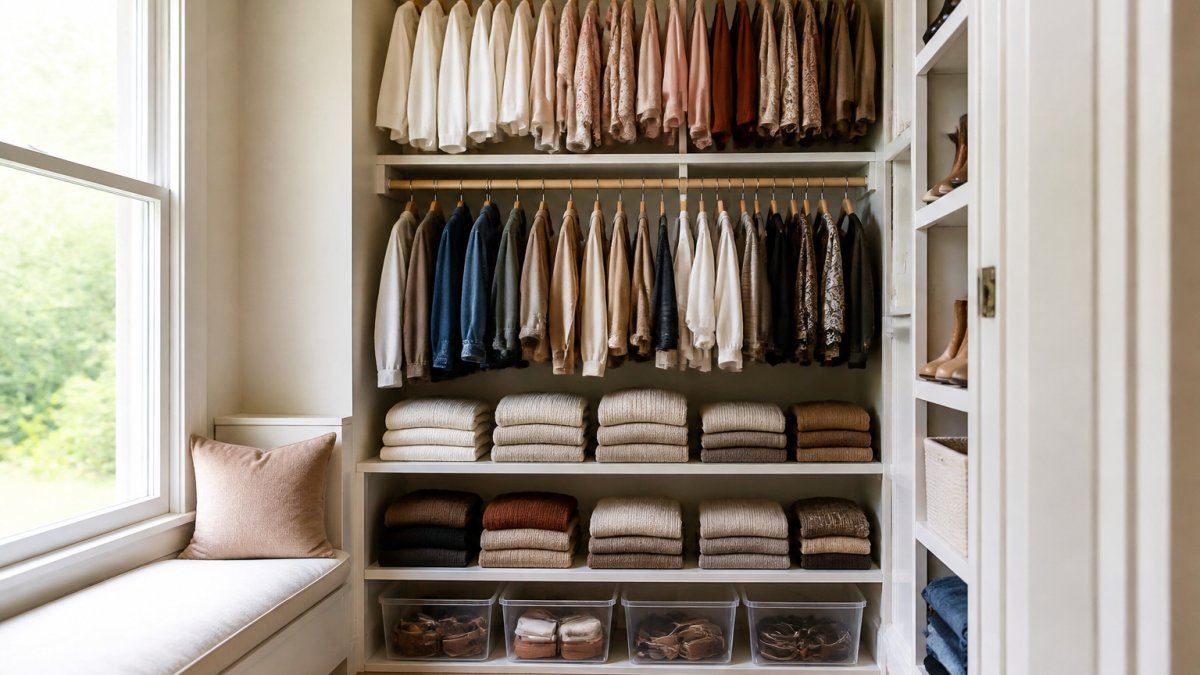
Group items by category, not by color. Keep all tops together, all bottoms together, all dresses together. This makes getting dressed faster because you see all your options at once. Within each category, hang or fold in color order so you can spot gaps at a glance.
For renters who can't drill holes, the reversible options are more capable than most people realize. Tension rods work for hanging scarves, belts, and lightweight bags, but they are not a substitute for a load-bearing clothes rod. Over-the-door organizers add shoe and accessory storage without a single screw. Freestanding closet towers and stackable cube units slide into the closet floor and come back out at move-out.
You can explore more small closet organization ideas tailored to your specific space and needs.
Step 5: Create Your Capsule Wardrobe Checklist
A checklist keeps you accountable. Write down every piece in your closet with a simple description: color, style, and what it pairs with.
Use this format:
| Item | Color | Pairs With |
|---|---|---|
| Button-down shirt | White | Jeans, trousers, skirts |
| T-shirt | Gray | Everything |
| Blazer | Navy | Trousers, jeans, dresses |
| Jeans | Dark wash | Tops, blazer, jacket |
| Trousers | Black | Tops, blazer, shoes |
Keep this checklist on your phone or printed in your closet. When you get dressed, you can quickly see outfit combinations.
Your checklist also prevents impulse buying. Before you buy something new, check if it works with at least three existing pieces. If it doesn't, skip it.
A capsule wardrobe checklist for professional work gives you a starting point if you dress for an office environment.
Step 6: Master Capsule Wardrobe on a Budget
Building a capsule wardrobe doesn't require spending a lot of money. Start with what you already own and add strategically.
Buy basics first. A white shirt, black trousers, and a neutral blazer are worth the investment. These pieces work for years. Quality fabrics like bamboo and modal last longer than cheap alternatives and feel better on your skin.
Shop your closet first. Before buying anything new, wear every piece you own for a month. You might discover outfits you forgot about.
Look for sales and discounts, but only on items that fit your color palette and lifestyle. One perfect piece beats five mediocre ones.
Thrift stores and consignment shops offer quality pieces at lower prices. You can find vintage blazers, quality jeans, and unique accessories without paying full price.
Set a monthly budget for new pieces. Even adding one item per month builds a cohesive wardrobe over time. Quality grows slowly, but it lasts.
Step 7: Maintain and Rotate Your Organized Closet
Organization only works if you maintain it, and in a small closet the maintenance is mostly rotation.
Set up the rotation. At each season change, pull everything that does not work for the next three months out of the closet and move it to storage. A common pattern is to keep 20-30 pieces active at a time and store the rest. Store off-season items in clear bins with lids under the bed, on the top shelf, or in a separate closet. Label each bin by season and contents, for example, "Fall/Winter: sweaters, boots, wool trousers." Clear bins beat opaque ones because you can confirm contents without opening them.
Track what you own. Keep a simple inventory on your phone, a notes app or spreadsheet is enough. List each stored item by category and season. Before you buy a replacement, check the list.
Run a weekly reset. Spend 10 minutes each week returning items to their zones, refolding stacks, and pulling anything that needs repair or washing. A weekly reset is faster than a monthly deep clean and keeps the closet from drifting.
Do a quarterly review. Every three months, ask three questions: Which pieces did I never wear? Which category has a gap? What needs replacing? Remove the unworn pieces, note the gap on your inventory, and add only what fills it.
Follow the one-in, one-out rule. Before bringing a new item into the closet, remove one old item. This keeps your total count stable and forces a real comparison between the new piece and what it replaces.
Wash and care for your clothes properly. Follow care labels. Quality fabrics deserve proper treatment. Bamboo and modal blends need gentle handling but reward you with durability.
The American Cleaning Institute on fabric care provides detailed guidance on washing different materials properly.
You can transition your capsule wardrobe between seasons with specific strategies that keep your small closet organized year-round.
Frequently Asked Questions
How do I organize a small closet without buying expensive organizers?
Start by using what you already have: drawer dividers from other rooms, shelf risers, or hanging shoe organizers. Vertical space is your best friend in a small closet, use slim hangers to fit more pieces on rods, stack folded items on shelves, and install additional shelving if your lease allows. Group clothes by category (tops, bottoms, dresses) to maximize visibility and reduce stress when getting dressed.
How many clothes should be in a capsule wardrobe for a small closet?
A functional capsule wardrobe for a small closet typically contains 25-35 pieces, including tops, bottoms, dresses, outerwear, shoes, and accessories. This count allows you to create multiple outfits while staying within limited space. Adjust based on your lifestyle and climate, someone in a warm area may need fewer jackets, while someone in a cold climate might prioritize layering pieces.
What is the best way to store seasonal clothes in a small closet?
Use clear plastic bins or vacuum-seal bags to store off-season clothing outside your closet, such as under the bed or in a hall closet. Label each container by season and item type. Keep only current-season pieces in your small closet to maximize space for everyday wear. Rotate storage every 3 months so your capsule wardrobe stays relevant to the weather.
How do I choose which clothes to keep for a capsule wardrobe?
Keep pieces that fit your lifestyle, flatter your body, and work with your chosen color palette. Prioritize versatile items like neutral tops, well-fitting jeans, and classic bottoms that mix and match easily. Ask yourself: Does this fit? Do I feel confident wearing it? Can it work with at least three other pieces in my closet? If the answer is no to any question, it's time to donate or sell it.
