

How Do You Fix Common Fit Problems in Petite Jeans?
Last Updated: October 25, 2026
Quick Summary
Petite jeans fit problems stem from standard sizing that doesn't match shorter frames, causing issues like ankle pooling, waist gapping, and excess fabric through the legs. Most problems are fixable through hemming, tailoring, or choosing petite-specific jeans with proper inseams between 27-31 inches and rises of 9-10 inches.
- Waistband gapping is the most common petite jeans fit problem, solved by taking in side seams or adjusting the back waistband.
- Hemming a quarter-inch to half-inch eliminates ankle pooling, the second most visible fit issue.
- Petite inseams typically range from 27 to 31 inches, compared to standard 30-32 inch inseams.
- A rise between 9 and 10 inches works well for most petite frames to prevent waist gapping.
- Stretch denim with at least 2-3% spandex recovers better and maintains shape better on petite frames.
Table of Contents
- Understanding Petite Jeans Fit Problems
- Jeans Gaping at the Waist: Causes and Solutions
- Excess Fabric Through the Legs and Pooling at the Ankle
- Finding the Best Inseam for Petite Jeans
- How to Hem Jeans for a Petite Frame
- Petite Denim Alterations Beyond Hemming
- Choosing the Right Petite Jeans From the Start
- Getting Started With Better-Fitting Petite Jeans
- Frequently Asked Questions
Understanding Petite Jeans Fit Problems
Petite jeans fit problems stem from one core issue: standard sizing assumes a specific body proportion that doesn't match petite frames. When you're shorter, the relationship between inseam, rise, and overall proportions shifts dramatically. A 29-inch inseam that fits someone 5'8" perfectly will pool at the ankles on someone 5'2". That's not a minor inconvenience, it's the difference between looking polished and looking like you're wearing hand-me-downs.
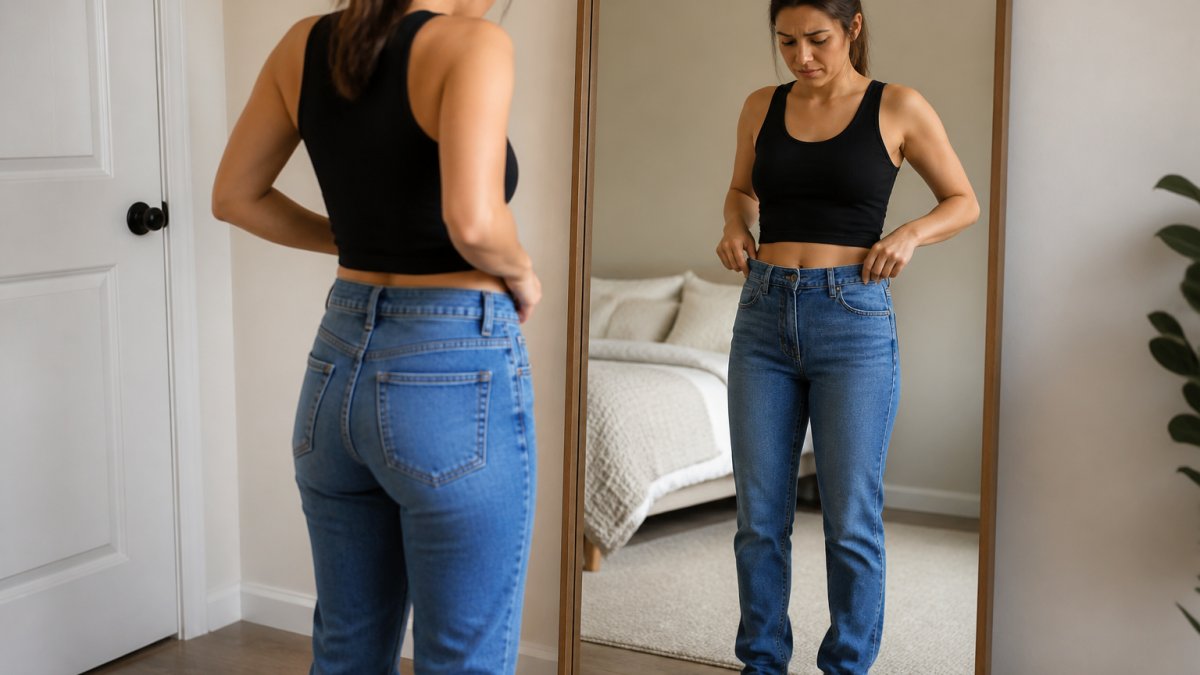
At D'LA Boutique, we understand that petite jeans fit problems affect how women feel in their clothes.
The good news is that most petite jeans fit problems follow predictable patterns. Once you understand what's causing the issue, you can fix it. Some fixes are simple. Others require tailoring. But all of them are solvable.
Common problem categories include:
- Excess fabric pooling at the ankle
- Waistband gapping at the back
- Tight thighs with loose calves
- Rise that sits too low or too high
- Knee placement that looks off
- Pockets positioned awkwardly on your frame
The key is learning to diagnose which problem you're facing, then matching it to the right solution.
Jeans Gaping at the Waist: Causes and Solutions
Waistband gaping is the most common petite jeans fit problem. Your waist fits, but there's a gap between the denim and your skin at the back.
Why the gap forms:
The rise, the distance from the crotch seam to the top of the waistband, is longer on regular-sized jeans. When you go down a size to get a petite inseam, the rise doesn't scale down proportionally.
How to identify it:
Stand in front of a mirror. If you can fit a finger or two between the waistband and your lower back, you have waist gapping.
Fixes for waist gapping:
Start with the simplest solution first. Many petite jeans fit problems can be solved without alterations. Try taking in the side seams.
If side seams don't work, consider a waistband adjustment. A tailor can take in the back waistband specifically. This is more precise than side seams and works well for petite frames where only the back gaps.
For a permanent solution, look for jeans with a shorter rise designed for petite proportions. The MR Petite Dark Wash Bootcut features a 9¾" rise specifically tailored for petite frames, eliminating the gap issue before it starts.

Excess Fabric Through the Legs and Pooling at the Ankle
This is the second most visible petite jeans fit problem. You buy jeans that fit your waist and hips perfectly, but the legs bunch up at your ankles.
Why pooling happens:
Standard inseams assume a certain leg length. A 30-inch inseam works for someone 5'8" but creates excess fabric on someone 5'2".
How to check for pooling:
Wear the jeans with the shoes you'll wear most often. Stand naturally. Look at where the denim hits your ankle.
Fixes for pooling:
The simplest fix is hemming. A quarter-inch to half-inch adjustment often eliminates pooling entirely. This is the most common alteration for petite jeans fit problems.
Some women prefer a cuffed look. Rolling or cuffing the hem intentionally gives you control over the length. This works especially well with straight-leg or wide-leg silhouettes.
If you're buying new jeans, look for petite-specific options. The Dark Wash Cuffed Stretch 31" Inseam Straight Jeans are designed with a 31-inch inseam.

Watch out: Hemming too much can change how the jeans break at your shoe.
Here are the most common petite jeans fit problems and how to address them.
| Problem | Cause | Fix |
|---|---|---|
| Pooling at ankle | Standard inseam too long for petite height | Hem a quarter-inch to half-inch |
| Waist gapping | Rise too long relative to petite proportions | Take in side seams or adjust back waistband |
| Excess fabric through legs | Inseam assumes taller body | Choose petite-specific inseam 27-31 inches |
| Thigh tightness with loose calves | Leg proportions don't match petite frame | Taper the leg through calf and ankle |
| Rise too low or high | Standard rise doesn't fit petite proportions | Look for 9-10 inch rise designed for petite |
| Crotch seam too low | Standard crotch placement misaligned | Raise crotch seam with experienced tailor |
Finding the Best Inseam for Petite Jeans
The inseam is the single most important measurement for petite jeans fit. Get this right, and most other fit problems disappear. Get it wrong, and no amount of tailoring fixes it perfectly.
What inseam actually measures:
The inseam runs from the inside of your ankle bone up through the crotch to the top of the rise. It's the length of fabric on the inside leg.
How to find your ideal inseam:
Measure yourself at home. Wear the shoes you'll wear with the jeans most often. Stand barefoot, then have someone measure from your ankle bone to your crotch. Write down that number.
Add half an inch to an inch for how the jeans will break at your shoe. If your measurement is 28 inches, try a 28.5 or 29-inch inseam.
Best inseam for petite jeans by height:
- Under 5'2": 27-28 inches
- 5'2" to 5'4": 28-29 inches
- 5'4" to 5'6": 29-30 inches
- 5'6" and up: 30-31 inches
These are starting points. Your actual best inseam depends on your specific proportions, not just height. Someone with a longer torso and shorter legs might need a different inseam than someone with opposite proportions.
Why inseam matters more than size:
Many women make the mistake of prioritizing the waist size over the inseam. They'll buy a size 26 because it fits their waist, even if the inseam is 32 inches.
How to Hem Jeans for a Petite Frame
Hemming is the most practical solution for petite jeans fit problems involving length. It's affordable, quick, and transforms how your jeans look.
When to hem:
MR Petite Dark Wash Bootcut: DK →
How much to hem:
Start conservatively. Remove a quarter-inch to a half-inch. This is often enough to eliminate pooling without changing how the jeans sit at your hip. You can always hem more.
Wear the jeans with your most-worn shoes. Stand naturally. Pinch the fabric at your ankle to see where it should break. Mark that spot with a pen. That's your hemline.
Hemming methods for petite jeans:
The most common method is a blind hem stitch. A tailor folds the hem up, stitches it so the stitching is hidden inside the fold, and creates an invisible hem.
Some people prefer a visible hem stitch for style. This creates a line of stitching visible on the outside of the jeans. It's trendy and works especially well with cuffed or cropped styles.
For a DIY option, iron-on hemming tape works for temporary fixes. It won't last through many washes, but it's useful if you're testing a new length before committing to tailoring.
Cost and timeline:
Professional hemming is an option. Most tailors complete it within a week.
Petite Denim Alterations Beyond Hemming
Sometimes petite jeans fit problems require more than hemming. If you love a pair of jeans but the fit isn't perfect everywhere, alterations beyond the hem can transform them.
Taking in the side seams:
This is the second most common alteration for petite jeans fit problems. A tailor removes a small amount of fabric from each side seam, bringing the overall fit closer to your body.
A tailor typically removes a quarter-inch to half-inch from each seam. More than that can change how the jeans drape and may throw off the pocket placement.
Shortening the rise:
For severe rise issues, a tailor can shorten the rise by taking fabric from the waistband.
Tapering the leg:
If the leg is too loose through the calf or ankle, a tailor can taper it. This narrows the leg opening, creating a slimmer silhouette.
Adjusting the crotch:
This is the most specialized alteration. If the crotch seam sits too low, a tailor can raise it. This requires skill and precision. Only attempt this with a tailor experienced in petite alterations.
When alterations aren't worth it:
If you're paying more in alterations than the jeans cost, it's time to look for a better-fitting pair.
Choosing the Right Petite Jeans From the Start
The best fix for petite jeans fit problems is prevention. Buying jeans that fit your petite proportions from the start can help address most issues.
What to look for:
Start with inseam. Find petite-specific options in your ideal length. Then look at the rise.
Check the pocket placement. On petite frames, standard-sized pockets can look oversized or positioned awkwardly. Petite jeans have pockets scaled to your proportions.
Look at the overall silhouette. Straight-leg and bootcut styles often work better for petite frames than skinny or wide-leg options. Straight-leg creates clean lines without excess fabric.
Fabric matters:
Stretch denim with spandex recovers better after wearing. This means less sagging and better retention of shape throughout the day.
Look for denim with at least 2-3% spandex. This gives you enough stretch for comfort without sacrificing structure.
Where to buy petite jeans:
Specialty boutiques like D'LA Boutique understand petite fit problems and stock options designed for shorter frames. You can explore petite jean recommendations.
The Judy Blue Mid Rise Crop Wide Leg Jeans offer a trendy silhouette with a 24.5-inch inseam, perfect for petite frames who want a cropped, modern look without excess fabric.
Sizing strategy:
Don't assume your regular size works for petite jeans. Many petite lines run differently. Try multiple sizes. Fit matters more than the number on the tag.
Getting Started With Better-Fitting Petite Jeans
Petite jeans fit problems are frustrating, but they're fixable. Start by identifying which problems you're facing. Is it pooling at the ankle? Waist gapping? Excess fabric through the legs?
For immediate relief, hemming solves most length-related issues. For lasting solutions, invest in petite-specific jeans designed for shorter frames. D'LA Boutique carries multiple petite options with proper inseams, rises, and proportions. Get started with stylish petite jeans that actually fit your frame, and experience the difference proper proportions make.
Frequently Asked Questions
What is the two-finger rule for jeans fit?
The two-finger rule is a simple check for waistband fit: unbutton your jeans and try to fit two fingers flat between your waist and the waistband. If you can fit more than two fingers, the waist is too loose and may gap. If you cannot fit any fingers, the waist is too tight. For petite jeans, this rule helps you identify whether gaping is a size issue or a proportion problem that alterations can fix.
How long should petite jeans be?
Petite jeans should hit just at or slightly above your shoe, with minimal to no break (bunching) at the ankle. Most petite inseams range from 27 to 30 inches depending on your height. At 5'4", an inseam of 28 to 29 inches typically works well. The key is measuring your own inseam: stand barefoot, place a measuring tape along your inner thigh from the crotch seam to your ankle bone, then subtract half an inch for shoe clearance.
Can petite jeans be altered to fit different body shapes?
Yes. Petite denim alterations can address length, waistband gaping, thigh fit, and rise adjustments. A tailor can taper legs, raise or lower the rise, take in the waist, or adjust the crotch seam. However, significant changes to the crotch or upper thigh are complex and costly. Simple hemming and waist adjustments are the most effective and affordable fixes for most petite fit issues.
What causes jeans to gap at the waist on petite frames?
Waistband gaping happens when the rise (distance from crotch to waistband) is too long for your proportions, or when the waist size is slightly too large. Petite frames often have shorter torsos, so a standard rise pulls away from the back. Check if the jeans sit comfortably on your hips; if they do but gap at the back, the rise is the issue. A tailor can take in the waistband or adjust the rise to solve this.
