

How to Build a Work From Home Style: Beginner Guide
Table of Contents
- Start With a Work From Home Capsule Wardrobe Essentials List
- Step 1: Define Your Personal Style and Comfort Rules
- Step 2: Choose the Best Fabrics for Remote Work Clothing
- Step 3: Master Layering for Easy Day-to-Night Transitions
- Step 4: How to Look Professional on Video Calls Without Sacrificing Comfort
- Step 5: Use Accessories and Styling Formulas to Elevate Your Look
- Common Mistakes to Avoid When Building Your Work From Home Style
- Conclusion: Build a System, Not Just a Wardrobe
- Frequently Asked Questions
Start With a Work From Home Capsule Wardrobe Essentials List
A work from home style is a curated collection of comfortable, polished clothing that makes you look put-together on camera while feeling like loungewear. The shift to remote work changed how we dress, but many women still struggle with the gap between pajamas and professional appearance.
The most important insight is that you do not need a massive closet. You need roughly 15 to 20 versatile pieces that mix and match effortlessly (thecut.com). A work from home capsule wardrobe essentials list starts with structured tops, soft tailoring, and bottoms with stretch waistbands that move with you throughout the day.
A common mistake is treating remote work attire as either fully casual or fully corporate. The sweet spot is elevated casual: pieces that read as intentional on screen but feel as comfortable as weekend clothes.
Step 1: Define Your Personal Style and Comfort Rules
Before buying anything, write down your non-negotiables. Do you hate tight sleeves? Do you need pockets? Do you run warm? These comfort rules matter more than trends because discomfort shows on your face during video calls.
Your personal style should guide every purchase. If you gravitate toward neutral tones, build around beige, olive, and black. If you love color, choose a palette of three to four shades that work together. The goal is outfit planning without friction: every top should pair with at least two bottoms you already own.
Start by pulling three outfits you already love wearing. Identify what they share. That common thread becomes your styling formula and your shopping filter.
Step 2: Choose the Best Fabrics for Remote Work Clothing
The best fabrics for remote work clothing hold their shape, resist wrinkles, and breathe through long sitting sessions. Natural blends like bamboo and modal excel here because they drape well without clinging and survive repeated washing without pilling or fading (peer-reviewed research).
Many women worry that softer fabrics look sloppy on camera. The fix is structure. A bamboo-blend top with a defined neckline or a modal sweater with clean shoulder seams photographs as polished while feeling like pajamas.
Avoid anything that requires dry cleaning or constant ironing. If you cannot throw it in the washing machine, it will end up at the bottom of your drawer by week two. D'LA Boutique prioritizes machine-washable bamboo and modal blends because busy women need low-maintenance options that still look elevated.
Step 3: Master Layering for Easy Day-to-Night Transitions
Layering is the single most effective strategy for work from home style because it solves the temperature problem and the transition problem at once. Mornings are cold, afternoons are warm, and evening plans require a quick upgrade.
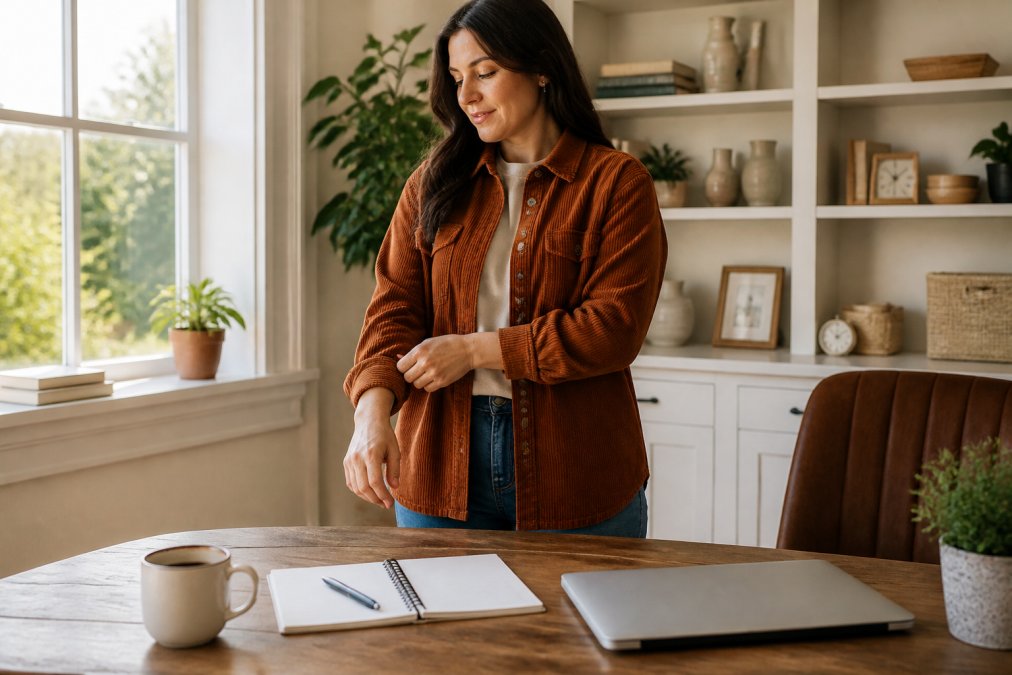
The key is soft tailoring: jackets that feel like cardigans but look like blazers. A corduroy shacket worn open over a fitted tee reads as smart casual for your 10 AM meeting, then closes up for a dinner outing at 7 PM.

Your layering pieces should follow the rule of three: one lightweight layer for warm days, one midweight jacket for cool days, and one heavier outer piece for winter. Each should coordinate with your core foundations so you can grab without thinking.
Step 4: How to Look Professional on Video Calls Without Sacrificing Comfort
Looking professional on video calls is a different skill than dressing for an in-person office. The camera compresses details, washes out color, and frames only a sliver of your outfit. The real depth is in understanding how webcams and lighting interact with your clothing choices.
The 'Waist-Up' System: Style for the Frame, Not the Full Mirror
Your camera frame typically captures you from the chest up. This creates a unique styling opportunity: prioritize extreme comfort below the frame while maintaining polish above it. Build a 'waist-up' wardrobe of 5-7 camera-ready tops that you rotate. These tops should have a defined collar (a crew neck, a pointed collar, or a V-neck that doesn't gape) because the camera flattens unstructured necklines.
Sleeves matter more than you think. A top with a three-quarter sleeve or a structured shoulder seam photographs better than a slouchy dolman sleeve. Solid colors in mid-tones, like rust, forest green, or dusty blue, are the most flattering. Avoid stark white, which can blow out highlights on your face, and avoid very tight black-and-white patterns, which cause a moiré effect on screen (nytimes.com).
The Color and Lighting Connection
Your clothing color interacts with your webcam's white balance. A bright red top can cast a red hue onto your face; a neon color can wash out your skin. The most reliable palette for video calls includes muted jewel tones and earth tones. If you love a bold color, wear it as an accent, a scarf, a collar, or jewelry, rather than a full shirt.
Lighting is the other half of this equation. If your primary light source is behind you, your face will be shadowed and your top will appear darker. Position your laptop so the light source is in front of you, slightly above eye level. A desk lamp with a warm bulb at a 45-degree angle to your face can make a $20 bamboo-blend top look like a high-end blazer on camera.
The 'Bottom Half' Psychology
Your lower half is invisible to your colleagues, but not to your brain. This is where 'enclothed cognition' comes into play, the psychological effect where clothing influences your mental state. Wearing pajama shorts or sweatpants can subconsciously signal 'rest mode' to your brain, making it harder to focus.
The solution is not 'hard pants' (denim or structured trousers). It is 'soft structure', leggings with a high waistband, joggers with a tailored taper, or soft-knit pants that feel like loungewear but have a defined silhouette. When you wear something that feels like work attire on your lower half, you are more likely to sit upright and speak with more authority.
A Practical Pre-Call Checklist
Before you hit 'join,' run this 30-second check:
- Neckline: Does the collar lie flat, or is it bunching?
- Color: Does the top contrast with your skin tone, or does it blend in?
- Sleeves: Are they at a length that looks intentional when you gesture?
- Light: Is your face well-lit, or is there a glare on your shoulders?
This system, curated tops, strategic color, and soft-structure bottoms, turns video call dressing from a daily guess into a repeatable formula. It is not about having more clothes; it is about having the right clothes for the webcam.
Step 5: Use Accessories and Styling Formulas to Elevate Your Look
Accessories are the fastest way to make a work from home outfit look intentional. A simple necklace, a watch, or a pair of earrings draws the eye to your face and signals effort. On camera, these small details read as polish. The deeper opportunity is not in buying new accessories, it is in curating a sustainable system from what you already own.
The 'Shop Your Closet' Formula
Most top-ranking articles push you toward buying a new capsule. A more sustainable and budget-friendly approach is to audit what you already have. Pull every top you own that you feel good in. Try each one on and rate it on two criteria: comfort (can you wear it for 6 hours?) and camera-readiness (does it have a defined neckline and flattering color?).
You will likely find that 60% of your existing wardrobe fails one of these tests. That is not a reason to shop, it is a reason to get creative. A top that is too loose around the neck can be layered under a structured cardigan. A blouse with a stain on the sleeve can become a layering piece under a jacket.
The 'Three-Outfit' Rotation
Instead of building a 20-piece capsule from scratch, start with a rotation of just three complete outfits. Each outfit should include a top, a bottom, and a layering piece. Wear Outfit A on Monday, Outfit B on Tuesday, and Outfit C on Wednesday. By Thursday, you will know which pieces feel right. This 'test-drive' method prevents you from buying a full wardrobe you end up ignoring.
Accessories as a Sustainable Upgrade
Before buying new accessories, look at what you already own with fresh eyes. A scarf from a previous season can be repurposed as a headband or necktie. A brooch can add a unique focal point to a plain top. The goal is not to accumulate more, it is to create more combinations from fewer pieces.
When you do need to buy, prioritize thrifted or secondhand options. Thrift stores and online resale platforms are excellent sources for high-quality natural fiber tops and blazers at a fraction of retail prices. A $12 thrifted silk blouse often outperforms a $40 fast-fashion polyester top in comfort and camera appearance.
Styling Formulas That Reduce Decision Fatigue
The 'uniform' approach is the most effective formula for beginners. Pick one bottom silhouette (e.g., black leggings or soft-knit trousers) and rotate through five different structured tops. This eliminates the daily question of 'what pants go with this?' and reduces morning decisions to a single choice.
The 'palette' approach is a close second. Choose three neutral base colors (e.g., black, olive, and beige) and one accent color (e.g., rust or dusty blue). Every top and bottom you own should fall into one of these shades. This ensures any combination looks intentional, even when you are in a hurry.
The Sustainability Payoff
A work from home style built on repurposing, thrifting, and rotation is not just better for your budget, it is better for the planet. The fashion industry is a major contributor to textile waste, and remote workers are not immune to the pressure to buy new 'work-from-home' clothes. By committing to a 'shop your closet first' rule, you reduce waste and build a wardrobe that is uniquely yours.
The most polished work from home style is not the one with the most new pieces. It is the one where every item has a purpose, fits your comfort rules, and works in your specific lighting and camera setup. That is a system you can sustain for years.
Common Mistakes to Avoid When Building Your Work From Home Style
The biggest mistake is buying for the life you had, not the life you have. That blazer from your office days feels like a costume at your kitchen table. Skip anything that does not pass the comfort test within five minutes.
Another common error is ignoring the wash-and-wear factor. If a piece requires special care, it will not survive your routine. Stick with wrinkle-free, machine-washable fabrics that look the same after ten washes.
Finally, do not neglect your lower half just because the camera cuts off at your waist. Many women report feeling less productive in full loungewear. The psychological shift of wearing real, comfortable clothing signals to your brain that you are at work, not at rest.
| Mistake | Why It Happens | Better Approach |
|---|---|---|
| Buying stiff office clothes | Habit from pre-remote days | Choose soft tailoring with stretch |
| Ignoring fabric care needs | Attracted to look, not upkeep | Prioritize machine-washable blends |
| Wearing full loungewear daily | Maximum comfort focus | Add structured tops for balance |
| No layering pieces | Underestimating temperature shifts | Invest in 2-3 versatile jackets |
Conclusion: Build a System, Not Just a Wardrobe
Building a work from home style that works takes thought, not money. Start with your capsule wardrobe essentials, define your comfort rules, and choose fabrics that survive real life. Layer for flexibility, style for the camera, and accessorize to finish.
D'LA Boutique curates pieces like the Corduroy Reversible Button Down Jacket that move from morning meetings to evening errands, and our bamboo and modal blends hold up wash after wash. Our plus-size collection ensures every woman finds her fit.
A wardrobe that works is one you can forget about. When your clothes support your focus instead of fighting it, you show up better for your team, your clients, and yourself. That is the real goal of any work from home style.
Frequently Asked Questions
What is the 3-3-3 rule for building a work from home capsule wardrobe?
The 3-3-3 rule is a simple styling method: pick three tops, three bottoms, and three layers (like jackets or cardigans) to create nine different outfits. For a work from home style, choose pieces that mix well together. You can wear a structured top for video calls and swap it for a softer one later. This rule helps you build a functional capsule wardrobe without owning too many items.
How can I look professional on Zoom while staying comfortable?
Focus on what the camera sees: your top half. Choose a structured top or a soft blazer in a solid color, and keep your bottoms comfortable, like joggers with a stretch waist. Natural light in front of you works best. Avoid busy patterns that can appear distorted on camera. Keep a neutral color palette for a polished look.
What are the best fabrics for remote work clothing?
The best fabrics for remote work clothing are those that breathe and stretch. Look for bamboo, modal, and cotton blends. These materials are soft, wrinkle-free, and hold up well after washing. They also allow for movement, which is important when you are sitting at a desk or moving around the house. Avoid stiff fabrics like heavy denim or scratchy wool.
How do I transition my work from home style to errands?
Build your outfit around versatile pieces that work for both. A pair of dark, comfortable jeans paired with a structured top and a utility jacket can go from a video call to the grocery store. Swap your slippers for clean sneakers or loafers. Adding a jacket and changing your shoes is the fastest way to make your look feel intentional and put-together for the outside world.
This article was written using GrandRanker