

Bamboo vs Modal Fabric Durability: Which Lasts Longer?
Table of Contents
- What Is Bamboo Fabric?
- What Is Modal Fabric?
- Bamboo vs Modal Fabric Durability: The Core Differences
- Is Bamboo Fabric Good for Summer?
- How to Wash Modal Clothing Properly
- Bamboo vs Modal Fabric Care Instructions
- Cost-Per-Wear: Which Fabric Offers Better Value?
- Microplastics and Environmental Concerns
- Frequently Asked Questions
Last Updated: September 1, 2026
What Is Bamboo Fabric?
Bamboo fabric is a regenerated cellulose textile made from bamboo pulp through the viscose method. Bamboo fabric has become increasingly popular for everyday wear because it combines softness with breathability. The fabric starts as bamboo wood, broken down into pulp and converted into fiber through a chemical process that creates the silky texture customers love.
Bamboo fabric has lower tensile strength compared to some alternatives, which influences durability over time. Despite this, many choose bamboo for its comfort and moisture-wicking properties, ideal for warm weather and active wear. The fiber is hypoallergenic, naturally breathable, and allows excellent thermal regulation, keeping you cool when temperatures rise. Bamboo is derived from a renewable resource that grows quickly without requiring pesticides or fertilizers.
What Is Modal Fabric?
Modal fabric is a regenerated cellulose textile produced from beechwood pulp using a process similar to viscose but with tighter environmental controls. The modal production process is more sustainable than traditional viscose because it recycles 99% of the solvents used during manufacturing, making it attractive for environmentally conscious consumers (peer-reviewed research).
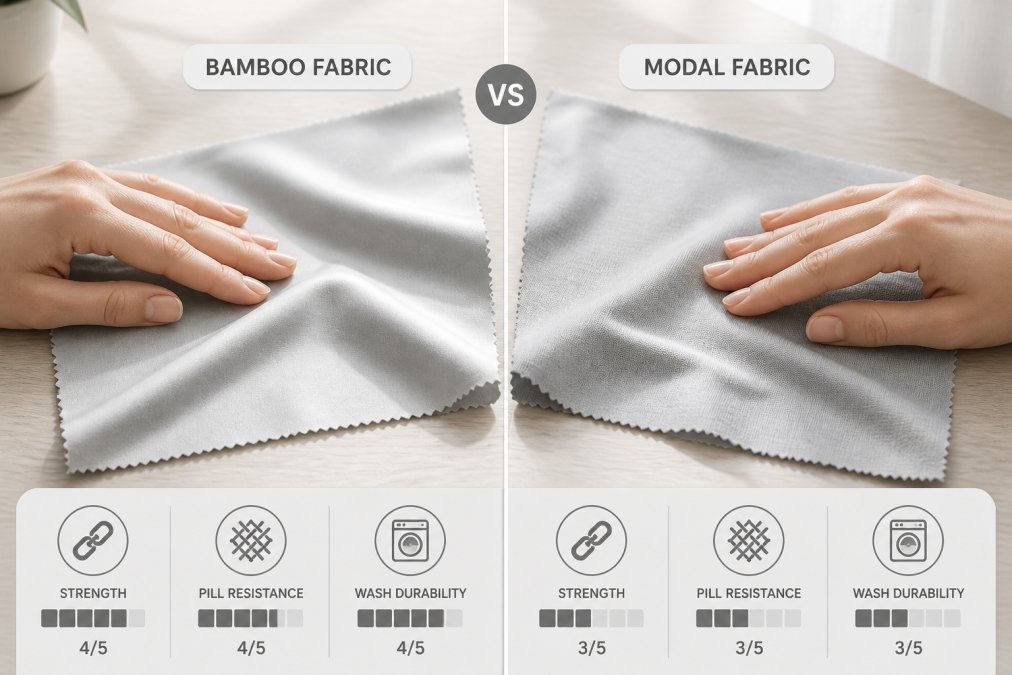
Modal fibers have higher tensile strength than bamboo, resisting breaking under stress more effectively (peer-reviewed research). This translates to better shape retention and longer garment lifespan. The fabric drapes beautifully and maintains softness even after multiple wash cycles, which is why it's often blended with other fibers in quality apparel. Modal typically resists pilling better and offers superior wrinkle resistance, requiring less ironing and maintaining a polished appearance longer.
Bamboo vs Modal Fabric Durability: The Core Differences
When comparing bamboo vs modal fabric durability, the differences come down to fiber structure, manufacturing process, and how each fabric responds to stress and washing. Both are regenerated cellulose, but the way they're processed creates distinct performance profiles.
Tensile Strength and Fiber Integrity
Tensile strength refers to how much stress a fiber can withstand before breaking. Modal fibers have significantly higher tensile strength than bamboo, meaning modal garments resist tearing and stress-related damage more effectively. Bamboo fabric's lower tensile strength means the fibers are more delicate and require gentler handling. When pulled or stretched aggressively, bamboo fibers are more likely to break, leading to small tears or weakened areas.
Modal's superior fiber elasticity allows it to flex and recover without permanent damage. The viscose process used for both fabrics creates regenerated cellulose, but modal's tighter manufacturing controls result in more uniform fibers with more predictable performance across multiple garments.
Pilling, Shrinkage, and Shape Retention
Pilling occurs when fibers work loose from the fabric surface and form small balls. Modal resists pilling significantly better than bamboo due to superior fiber integrity. Bamboo fabric tends to shrink more noticeably after washing, particularly in hot water, typically 3-5% in the first few washes (peer-reviewed research). Modal shrinks less because its fibers are more stable and less reactive to temperature changes.
Shape retention refers to how well a garment maintains its original fit over time. Modal excels here because fibers don't relax as much after washing. Bamboo garments may gradually lose their shape, becoming slightly baggier or stretched in certain areas, particularly in pieces that experience regular stretching like t-shirt necklines.
Weave Impact on Long-Term Durability
The weave structure, how tightly fibers are interlocked, dramatically affects garment longevity. A tight weave distributes stress across more fibers, extending garment life. Modal fabrics are often woven more tightly than bamboo, contributing to superior durability.
D'LA Boutique's bamboo-modal blend t-shirts use a balanced weave that combines bamboo's softness with modal's durability benefits. This blend approach gives you comfort advantages while improving longevity through modal's superior tensile strength.

Is Bamboo Fabric Good for Summer?
Bamboo fabric is excellent for summer wear because of its superior moisture-wicking and breathability. The fiber structure allows sweat to evaporate quickly, keeping you cooler and drier than cotton or synthetic fabrics. The thermal regulation properties naturally dissipate heat, making it ideal for hot climates.
Modal also performs well in summer, though it's slightly less breathable than bamboo. Both fabrics keep you dry during active wear. Bamboo can feel cool to the touch initially, which many love in summer. D'LA Boutique's bamboo-modal blend t-shirts are popular for warm-weather basics, offering bamboo's cooling properties with modal's durability.
How to Wash Modal Clothing Properly
Proper care extends modal's impressive lifespan. Turn garments inside out before washing to reduce pilling and protect the surface. Use cool or lukewarm water, never hot, as heat can cause modal fibers to relax and shrink slightly.
Select a gentle or delicate cycle on your washing machine, or hand-wash delicate pieces. Use mild detergent designed for delicate fabrics; harsh chemicals weaken fibers over time. Avoid fabric softeners and bleach entirely, fabric softeners reduce moisture-wicking ability, and bleach breaks down cellulose fibers. Use oxygen-based cleaners for whitening instead.
Air-dry modal garments whenever possible, laying flat or hanging in a well-ventilated area away from direct sunlight. If using a dryer, select the lowest heat setting. High heat accelerates fiber degradation and causes shrinkage.
Bamboo vs Modal Fabric Care Instructions
Bamboo requires more careful handling than modal, particularly during washing. Turn bamboo pieces inside out and use cool water exclusively, as warm or hot water increases shrinkage and causes color fading. Hand-washing is ideal, though a gentle machine cycle works if you place items in a mesh laundry bag.
Use mild detergent, avoiding fabric softeners and bleach. Minimize agitation during washing since bamboo fibers are more delicate. Air-dry completely; never use a dryer if you want to preserve shape and size. Hang or lay flat on a drying rack.
For both fabrics, wash in cold water with like colors to prevent dye transfer. Fold rather than hang when storing to prevent stretching. Keep garments away from direct sunlight during storage, as UV exposure fades colors and weakens fibers. Modal tolerates slightly warmer water and dryer heat better than bamboo, making it lower-maintenance if laundry convenience matters to you.
Cost-Per-Wear: Which Fabric Offers Better Value?
Cost-per-wear is calculated by dividing the garment's price by the number of times you'll wear it before it becomes unwearable. D'LA Boutique's bamboo-modal blend t-shirts start at $29.00. If you wear one 100 times before significant wear, your cost-per-wear is approximately $0.29 per wearing. Compare that to a $15 fast-fashion t-shirt lasting 30 wears at $0.50 per wearing.
Modal garments typically last longer than bamboo, delivering better cost-per-wear if priced similarly. A modal piece lasting 150 wears at $29 costs $0.19 per wearing, better value than bamboo lasting 100 wears at the same price. However, if bamboo pieces are priced significantly lower, the cost-per-wear advantage might favor bamboo.
Quality blends offer a middle ground. D'LA Boutique's bamboo-modal blend optimizes cost-per-wear by extending garment life without sacrificing comfort.
| Fabric Type | Expected Lifespan | Typical Price | Cost-Per-Wear (100 wears) | Best For |
|---|---|---|---|---|
| Bamboo | 60-80 wears | $20-30 | $0.25-0.50 | Budget-conscious, warm-weather basics |
| Modal | 120-150 wears | $25-40 | $0.17-0.33 | Durability-focused, frequent wearers |
| Bamboo-Modal Blend | 100-120 wears | $25-35 | $0.21-0.35 | Balance of comfort and longevity |
Microplastics and Environmental Concerns
Both bamboo and modal are regenerated cellulose fabrics derived from natural sources rather than petroleum-based synthetics. However, manufacturing processes and fiber shedding raise legitimate environmental concerns.
Microplastic shedding occurs when fabric fibers break loose during washing and enter wastewater systems. Bamboo's lower tensile strength means it sheds more fibers than modal, contributing more microplastics to the environment. Modal's superior fiber integrity results in less shedding, making it more environmentally responsible from a microplastics perspective.
Modal's manufacturing is significantly more sustainable because it recycles 99% of solvents used during production, while traditional viscose processes have lower recovery rates. Bamboo's advantage lies in the source material itself, it grows rapidly without requiring pesticides or fertilizers and regenerates quickly after harvesting. The environmental trade-off is that while the raw material is sustainable, manufacturing and fiber shedding create downstream concerns.
The most sustainable choice is to buy durable pieces you'll wear frequently and care for properly to extend their lifespan. A modal garment worn 150 times has less environmental impact per wearing than a bamboo piece worn 80 times. D'LA Boutique's commitment to quality materials reflects an understanding that durability is fundamental to sustainability.
The choice between bamboo and modal depends on your priorities. If you value softness and breathability, bamboo delivers unmatched comfort. If durability and low-maintenance care matter more, modal is the clear winner. D'LA Boutique's bamboo-modal blend t-shirts offer a practical compromise, combining bamboo's softness and cooling properties with modal's superior tensile strength and shape retention. At $29.00, they represent solid value for anyone seeking basics that balance comfort with longevity. Explore our collection of bamboo-modal pieces and experience the difference quality materials make in everyday wear.
Frequently Asked Questions
Q: Is modal fabric more durable than bamboo?
A: Modal generally offers better durability and shape retention over time. Modal fibers have higher tensile strength, meaning they resist breaking and stretching better during wash cycles. Bamboo fabric softens with each wash, which some prefer for comfort but can reduce longevity. For garments you want to last without visible wear, modal typically outperforms bamboo. However, proper care extends both fabrics' lifespans significantly.
Q: Does bamboo fabric shrink more than modal?
A: Bamboo fabric tends to shrink more than modal, especially in hot water. Bamboo shrinkage can reach 5-10% if washed incorrectly, while modal shrinks 2-5% under the same conditions. Both fabrics shrink less when washed in cold water and air-dried. To minimize shrinkage in bamboo garments, always use cold water, gentle cycles, and lay flat to dry. D'LA Boutique's bamboo/modal blend pieces balance these properties for better shape retention than pure bamboo.
Q: What are the downsides of modal fabric?
A: Modal's main drawbacks include higher production costs (making garments more expensive), and it can pill under friction if lower-quality weaves are used. Modal also requires careful washing to avoid color fading over time. Despite these concerns, modal resists pilling better than bamboo when constructed with tighter weaves. The trade-off is that modal typically costs more upfront but lasts longer, making it a better long-term investment for frequently-worn pieces.
Q: How do I know if a bamboo or modal blend will actually hold up after multiple washes?
A: Check the fabric weight (measured in GSM, or grams per square meter), heavier fabrics (over 150 GSM) last longer. Look for tight, consistent weaves rather than loose knits. Read care labels carefully and follow them exactly: cold water, gentle cycles, and air-drying extend life dramatically. D'LA Boutique's bamboo/modal blend pieces are designed for durability with quality construction. Proper care, washing in cold water and avoiding high heat, is the biggest factor in longevity for both fabrics.
This article was written using GrandRanker